
ADHD, vitamin deficiencies, and picky eating are more connected than most parents realize.
Unfortunately, this connection is rarely discussed in traditional ADHD conversations.
In this fifth and final part of our ADHD Biology Series, we’re unpacking nutritional deficiencies in kids with ADHD: why they’re common, how they link to picky eating and impulsivity, and what happens when the brain is trying to function without the raw materials it depends on.
In Part 1 of this series, we talked about blood sugar regulation and its effect on ADHD symptoms. In Part 2, we covered the gut–brain connection. In Part 3, we looked at how hidden food reactions can make ADHD symptoms worse. In Part 4, we discussed poor detox.
Now we’re opening Layer Five: nutrient deficiencies.
Many ADHD parents think their child won’t cooperate, but when vitamin deficiencies are at play, it’s actually because neurologically, they can’t cooperate.
Let’s break down what nutrients actually do in the ADHD brain, how deficiencies develop (even in kids who eat “fine”), and how to figure out what your child may really be missing.
The Starving Brain: Why Nutrients Matter in ADHD
The brain is not powered by willpower; it’s powered by nutrients.
Every thought your child has, every emotion they regulate, every impulse they stop (or don’t)…All of it depends on tiny biochemical reactions happening every second inside the brain, and those reactions require raw materials.
The brain runs on micronutrients, not just calories.
Iron, zinc, magnesium, omega-3 fatty acids, vitamin D, and B-vitamins are not “nice extras.” They are the building blocks for neurotransmitters, the chemical messengers that control focus, mood, motivation, sleep, and emotional regulation. Without adequate levels of these nutrients, the brain cannot fire properly.
Unfortunately, your child may be eating plenty of food and still be lacking nutrients. That’s because calories alone do not equal nourishment. A child can consume enough energy to grow and still be deficient in the micronutrients required for emotional regulation and executive function. You can’t build dopamine out of crackers or regulate the mood with carbs alone.
To make matters even more complicated, sometimes a child can be eating well, but their bodies can’t absorb or use what they’re consuming.
Gut dysfunction, chronic inflammation, mold exposure, food sensitivities, and oxidative stress can all interfere with nutrient absorption.
If the gut lining is inflamed or permeable, nutrients may not go where the body most needs them. If inflammation is high, the body diverts resources away from optimal brain function. If poor detox is at play (like we discussed in Part 4), nutrients like glutathione and B-vitamins get depleted faster than they can be replenished.
So even when a parent says, “But we eat really healthy,” the labs sometimes tell a different story.
The problem is that the brain is starving, not for calories, but for micronutrients. When this is the case, we need to stop asking, “Why won’t they just try harder?” And start asking: “What does their brain need more of?”
One of the clearest places we see this nutrient gap show up is in the relationship between picky eating and ADHD symptoms.
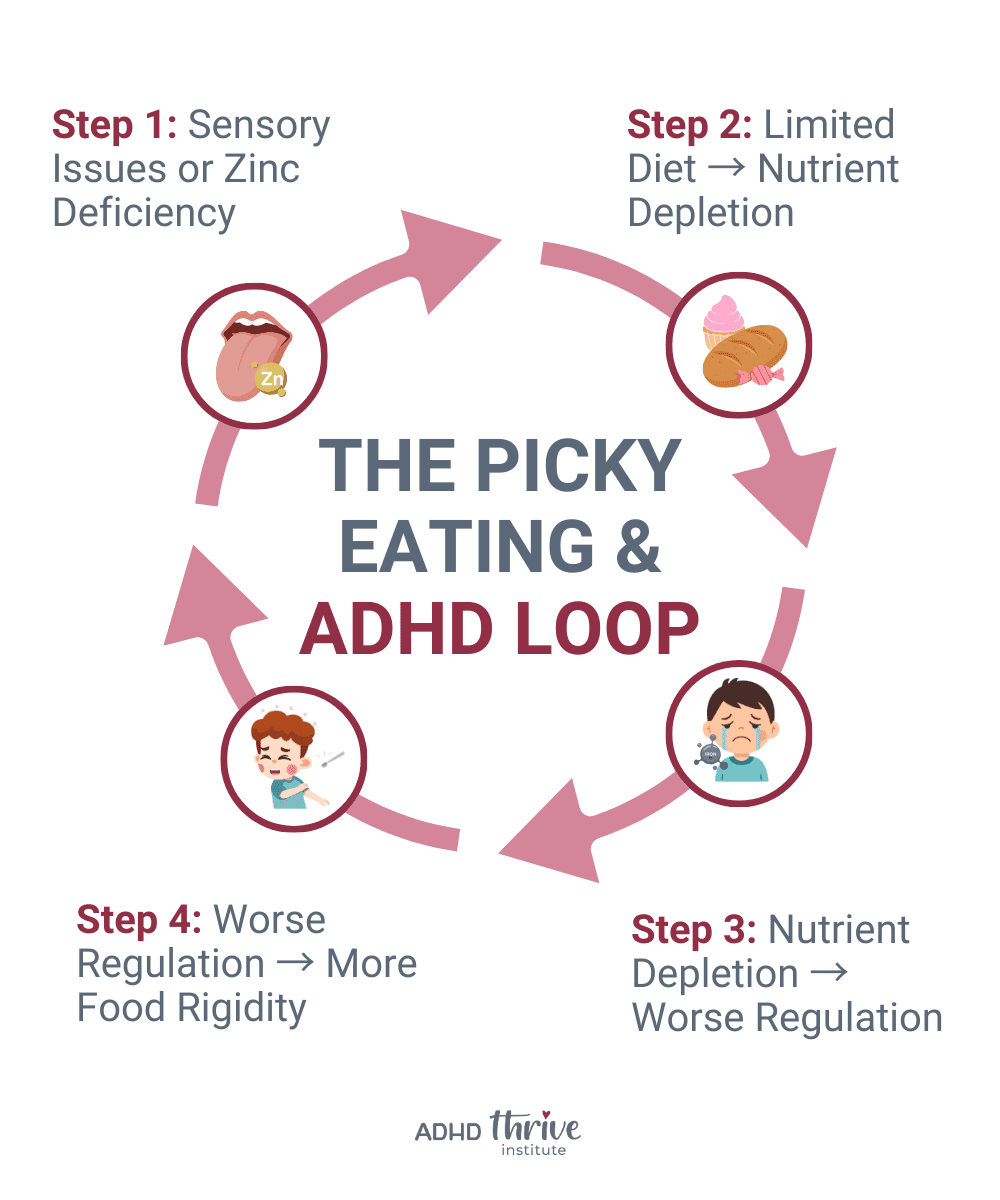
Picky eating and ADHD behavior are not always two separate problems. Sometimes, they’re connected.
Let’s walk through it.
Step 1: Sensory Issues or Zinc Deficiency → Picky Eating
Some kids start with sensory sensitivity. Textures feel overwhelming, smells feel intense, or foods that were fine yesterday suddenly “taste weird.”
But there’s a biological layer beneath picky eating that many parents don’t realize – zinc deficiency can literally change how food tastes.
This is because zinc plays a critical role in taste bud structure and function. When zinc levels are low, taste perception dulls or distorts. Food can taste metallic, bitter, or just “off.”
[To learn more about zinc, tune in to this podcast episode.]
What looks like defiance may actually be altered sensory input. Your child isn’t trying to be difficult. Their brain is interpreting food differently, and when eating feels unpleasant, the menu shrinks.
Step 2: Limited Diet → Nutrient Depletion
Now the food list gets smaller. Maybe your child will only eat five beige foods or carbs at every meal with very little protein.
Over time, this restricted intake leads to nutrient depletion. As the diet becomes narrower, the nutrient tank empties and the brain starts running on fumes.
Step 3: Nutrient Depletion → Worse Regulation
This is often when ADHD symptoms ramp up even more.
Low iron can lead to a dopamine drop, which then leads to lowered motivation or emotional instability. Low magnesium can lead to a nervous system that struggles to calm down. And the list goes on.
Step 4: Worse Regulation → More Food Rigidity
When regulation drops, anxiety rises. When anxiety rises, rigidity increases. And when rigidity increases, food becomes one of the few controllable things in their world.
So they tighten further and refuse even more food.
The cycle literally feeds itself.
This is why many kids with ADHD are also picky eaters. They’re connected because of nutrient gaps. Until you interrupt the nutrient depletion driving both, you can work on behavior forever and never quite get ahead.
Key Nutrient Deficiencies Linked to ADHD Symptoms
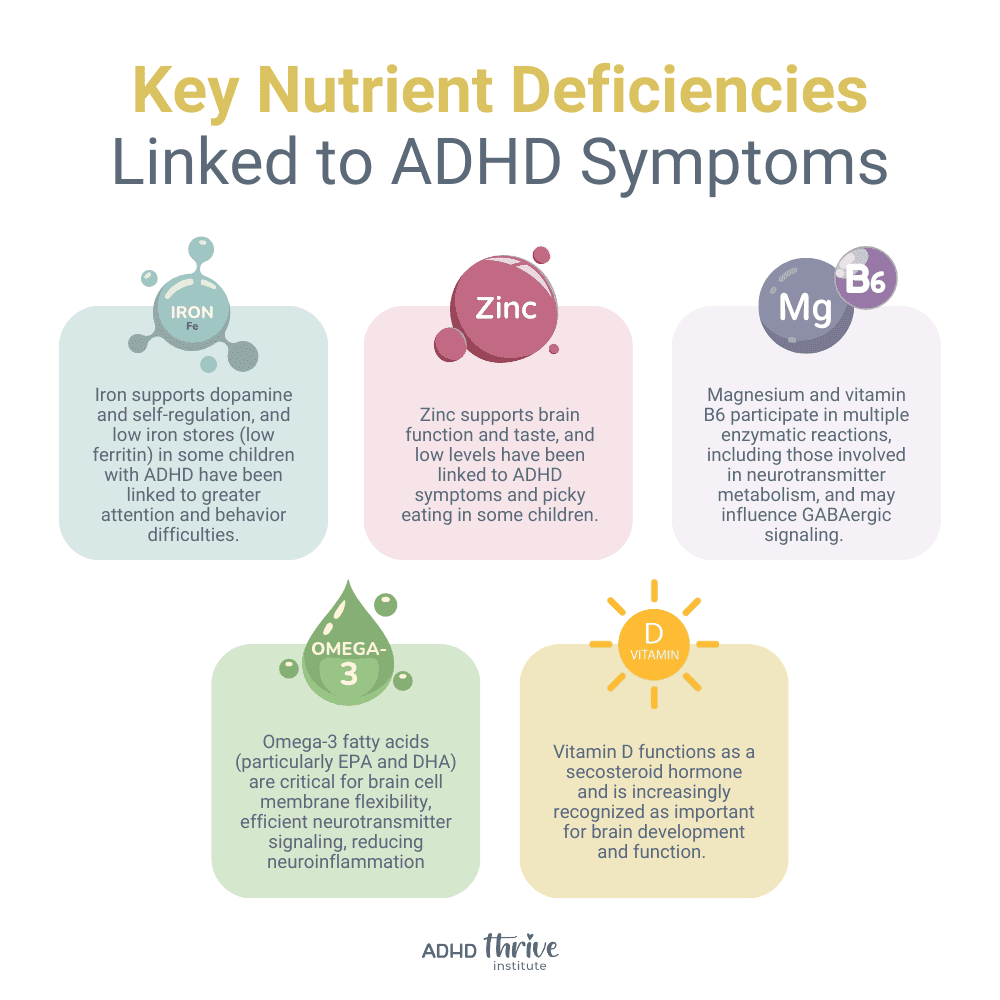
Here are some of the most common deficiencies we see in children with ADHD:
Iron
Iron is not just about preventing anemia; it is a cofactor for enzymes involved in dopamine synthesis, and dopamine plays an important role in focus, motivation, and impulse control.
Low iron status has been associated with poorer attention, increased restlessness, and other behavioral difficulties in some children, including those with ADHD.
When testing iron status, it’s important to look at ferritin, which measures iron storage in the body. Some studies report that children with ADHD can have normal hemoglobin levels but lower ferritin on average than control children, suggesting reduced iron stores in a subset of this population.
Research supports a possible link: several studies and meta-analyses have found lower average ferritin levels in children with ADHD compared with controls, and lower ferritin has been associated with greater symptom severity.
If iron is low, dopamine-related pathways may be affected, which could make self‑regulation more difficult in some individuals.
Zinc
Zinc is an often overlooked nutrient in relation to ADHD.
It plays a key role in:
- Dopamine metabolism
- Neurotransmitter signaling
- Immune balance
- Taste perception
As already mentioned, zinc deficiency can alter taste perception and taste bud function, and low zinc has been linked to symptoms such as reduced taste acuity or altered taste in some individuals. When zinc is low, food can taste metallic, bitter, or simply “off.”
This is one biological reason why picky eating and ADHD might overlap in some children.
Some studies have reported lower zinc levels in groups of children with ADHD compared with controls, and several small trials suggest zinc supplementation may modestly improve hyperactivity and impulsivity in children who are deficient or have low baseline zinc.
Magnesium & B6
Magnesium and vitamin B6 participate in multiple enzymatic reactions, including those involved in neurotransmitter metabolism, and may influence GABAergic signaling.
When magnesium or B6 are low, you may see:
- Anxiety
- Restlessness
- Difficulty falling asleep
- Emotional reactivity
- Muscle tension
Several small studies have reported lower magnesium levels in some children with ADHD, and small trials have suggested that combined magnesium and B6 supplementation may reduce hyperactivity or improve behavior in subsets of children.
A nervous system without enough magnesium is similar to a car without brakes. It can go, but it can’t slow down easily.
Omega-3 Fatty Acids
Omega-3 fatty acids (particularly EPA and DHA) are critical for:
- Brain cell membrane flexibility
- Efficient neurotransmitter signaling
- Reducing neuroinflammation
Many studies have found that children with ADHD tend to have lower blood levels of omega‑3 fatty acids on average than peers, and lower levels have been linked to more severe symptoms in some research. Meta‑analyses suggest that omega‑3 supplementation produces small but statistically significant improvements in ADHD symptoms (particularly inattention) in some children, with somewhat larger effects reported in those with low baseline omega‑3 status.
Think of omega-3s as the oil that keeps the engine running smoothly. Without them, signals don’t pass as efficiently, processing slows, and reactivity rises.
Vitamin D
Vitamin D functions as a secosteroid hormone and is increasingly recognized as important for brain development and function.
It supports:
- Serotonin production (linked to mood stability)
- Melatonin regulation (linked to sleep cycles)
- Immune modulation
- Inflammation control
Several observational studies have found lower average vitamin D levels in children with ADHD compared to controls, and early interventional studies suggest that correcting vitamin D deficiency may modestly improve ADHD symptoms or related issues such as mood in some children.
Low vitamin D status has been associated with higher rates of mood symptoms, anxiety, and sleep problems in various populations, and these issues may be more noticeable during months with less sunlight.
These nutrients are not optional extras. They are the fuel lines to the brain systems responsible for focus, flexibility, calm, and resilience. When even one of them is low, the system compensates. When several are low at once, that’s when parents describe their child as:
“Always on edge.”
“Exploding over nothing.”
“Impossible to settle.”
Remember, sometimes it’s not just about what your child is eating. It’s also about what their body can actually absorb.
Gut inflammation, food sensitivities, chronic stress, mold exposure, and oxidative stress can all interfere with nutrient uptake. If the gut lining is irritated or permeable, if inflammation is high, or if detox pathways are under strain, the body may struggle to properly extract, convert, and deliver nutrients where they’re needed most.
Intake is only half the equation. Absorption matters just as much.
Signs Your Child’s Brain May Be Under-Fueled
If your child’s brain really is like a fuel tank, the question becomes: how do you know when it’s running low?
Here are clues to watch for:
☑️ Does your child get easily frustrated or emotionally explosive over small things?
☑️ Do they seem wired but anxious, unable to calm their body or fall asleep?
☑️ Are they constantly seeking movement, noise, or stimulation—yet struggle to stay focused?
☑️ Do they gag at certain textures, reject familiar foods, or claim things “taste weird”?
☑️ Do they have big mood swings after dark or seem emotionally fragile in the mornings?
These are patterns, and they’re trying to tell you something.
Should You Test for Nutrient Deficiencies?
By the time parents reach this point, they usually ask the same question: “Should we test for this…or just try supplements?”
Here’s my honest answer: When it comes to ADHD and nutrient deficiencies, guessing is not a strategy.
But there’s an important distinction to understand first.
Traditional Lab Work vs. Functional Lab Testing
Most pediatricians will run standard blood work if you ask, and that can be helpful. But traditional lab testing is designed to detect disease, not early imbalances.
It uses broad reference ranges, which means your child’s results may come back labeled “normal”… even if they are far from optimal for brain function.
For example, a magnesium level can fall within the “normal” range but still be too low to properly regulate the nervous system. Ferritin (iron storage) may be technically acceptable but not high enough to adequately support dopamine production.
This is where functional lab testing differs.
Instead of asking, “Is your child sick?” functional testing asks, “Is your child optimal?” and, “If not, what’s the biological underlying stressor causing the issue?”
Because nutrient deficiencies rarely exist in isolation.
A child with low iron may also have gut inflammation preventing absorption.
A child with low zinc may also have food sensitivities driving depletion.
A child with low omega-3s may also show elevated inflammatory markers.
Traditional lab work rarely investigates these biological layers. Functional testing does.
If you’d like a deeper breakdown of how functional lab testing works, including the specific panels we use, I’ve written a 4-part in-depth guide here:
Part 1 – the Wheat Zoomer Test and the Food Sensitivity Test
Part 2 – the Organic Acid Test
Part 3 – the Gut Stool Test
Part 4 – the Kryptopyrrole Test
Here’s the key takeaway for today: When the brain is starving, you don’t guess what to feed it. You test. Then you nourish intentionally.
The ADHD Thrive Decoder Kit – Identifying the Starving Brain
This is exactly why we created a way for parents to identify which biological layer is speaking, without having to guess.
Introducing the ADHD Thrive Decoder Kit!
This kit is designed to help you identify which of the five biological stressors may be driving your child’s symptoms, including the “starving brain” layer.
Inside the kit, you’ll get:
✔ A physical Decoder Wheel that helps you see which biological stressor is most likely active
✔ Clear, parent-friendly guides that translate behavior into biology
✔ Simple “Try This Today” steps that help you start supporting the right system immediately
This is NOT another program to manage but instead a physical tool we will mail right to your doorstep. Best of all, it’s free. You cover shipping, and we’ll take care of the rest.
(Please note that at this time, shipping is available within the United States only.)
Because when you know which layer is talking, you stop guessing….and when you stop guessing, you stop chasing symptoms.
If nutrient deficiencies might be driving your child’s ADHD symptoms, this will help you see it clearly.
Full Series Recap: The Five Biological Stressors Behind ADHD Symptoms
Over the past several weeks, we’ve peeled back the layers beneath ADHD behavior.
Layer 1: Blood Sugar Dysregulation
How unstable glucose levels fuel emotional chaos and impulsivity.
Layer 2: Gut–Brain Dysfunction
How inflammation and gut imbalance disrupt neurotransmitters.
Layer 3: Food Reactions
How delayed immune responses quietly drive behavioral shifts.
Layer 4: Poor Detox
How an overloaded system affects ADHD symptoms.
Layer 5: Nutrient Deficiencies (this post)
How a brain running low on vitamins and minerals struggles to regulate itself.
By now, you understand that behavior is biology.
And when you support biology, the behavior will follow.
FAQs About Nutrient Deficiencies and ADHD
Can nutrient deficiencies cause ADHD symptoms?
Nutrient deficiencies don’t “cause” ADHD on their own, but research shows that low levels of specific nutrients can worsen ADHD symptoms. These nutrients are required to produce dopamine and regulate mood, focus, and impulse control. When levels are low, symptoms often intensify.
Does iron deficiency cause impulsivity?
Iron plays a critical role in dopamine production. Low ferritin (iron storage) levels have been linked to increased impulsivity, emotional reactivity, and reduced attention in children. While iron deficiency isn’t the sole cause of impulsivity, inadequate iron can significantly impair regulation in children with ADHD.
Why are kids with ADHD picky eaters?
Picky eating and ADHD are often connected through nutrient imbalances and sensory sensitivity. Zinc deficiency can alter taste perception, making foods taste bitter or “off.” Gut dysfunction and inflammation can also increase texture sensitivity. Over time, a restricted diet can worsen nutrient deficiencies, creating a cycle of food rigidity and behavioral challenges.
Should I give my child supplements for ADHD?
Supplementation can be helpful, but only when it’s targeted. Randomly adding supplements without testing may miss the real issue or create imbalance. Functional lab testing helps identify specific deficiencies so supplementation can be personalized and effective.
Resources:
Arnold LE, DiSilvestro RA, Bozzolo DR, et al. Zinc for attention-deficit/hyperactivity disorder: placebo-controlled double-blind pilot trial. J Child Adolesc Psychopharmacol. 2011;21(1):1–19.
Link: https://pubmed.ncbi.nlm.nih.gov/21309695/

Bekaroglu M, Uysal O, Kosan C, et al. Zinc deficiency in attention-deficit hyperactivity disorder. Psychiatry Clin Neurosci. 1996;50(2):89–93.
Link: https://pubmed.ncbi.nlm.nih.gov/8946267/

Bener A, Kamal M, Bener H, Bhugra D. Higher prevalence of iron deficiency as strong predictor of attention deficit hyperactivity disorder in children. Ann Med Health Sci Res. 2014 Sep;4(Suppl 3):S291-7. doi: 10.4103/2141-9248.141974. PMID: 25364604; PMCID: PMC4212392.

Bloch MH, Qawasmi A. Omega-3 fatty acid supplementation for the treatment of children with attention-deficit/hyperactivity disorder symptomatology: systematic review and meta-analysis. J Am Acad Child Adolesc Psychiatry. 2011;50(10):991–1000.
Link: https://pubmed.ncbi.nlm.nih.gov/21961774/

Bosc M, et al. Magnesium, hyperactivity and autism in children. In: Vink R, Nechifor M, eds. Magnesium in the Central Nervous System. University of Adelaide Press; 2011. Chapter reviewing Mg–B6 in ADHD.
Link (book landing page): https://www.ncbi.nlm.nih.gov/books/NBK507249/

El Baza F, El Wakeel L, El-Hamamsy M. Magnesium supplementation in children with attention deficit hyperactivity disorder. Egypt J Med Hum Genet. 2015;16(2):181–186.
(Journal site/example access point) Link: https://www.sciencedirect.com/science/article/pii/S1110863015000555

Hawkey E, Nigg JT. Omega-3 fatty acid and ADHD: a meta-analysis. J Atten Disord. 2014;18(4):275–284.
Link: https://pubmed.ncbi.nlm.nih.gov/22451203/

Konofal E, Lecendreux M, Arnulf I, Mouren M. Iron Deficiency in Children With Attention-Deficit/Hyperactivity Disorder. Arch Pediatr Adolesc Med. 2004;158(12):1113–1115. doi:10.1001/archpedi.158.12.1113

Milte CM, Parletta N, Buckley JD, et al. Eicosapentaenoic and docosahexaenoic acids, cognition, and behavior in children with ADHD. Nutr Rev. 2012;70(3):203–216.
Link: https://pubmed.ncbi.nlm.nih.gov/22364183/

Mousain-Bosc M, Roche M, Polge A, et al. Improvement of neurobehavioral disorders in children supplemented with magnesium–vitamin B6. Magnes Res. 2006;19(1):46–52.
Link: https://pubmed.ncbi.nlm.nih.gov/16846100/

Prasad AS. Zinc in human health: effect of zinc on taste and smell. J Trace Elem Med Biol. 2014;28(4):459–463.
Link: https://pubmed.ncbi.nlm.nih.gov/25019153/

Sharif MR, Madani M, Tabatabaei F, et al. Vitamin D levels in children with attention deficit hyperactivity disorder. Iran J Child Neurol. 2015;9(4):48–53.
Link: https://www.ncbi.nlm.nih.gov/pmc/articles/PMC4733221/

Wang Y, Huang L, Zhang L, Qu Y, Mu D (2017) Iron Status in Attention-Deficit/Hyperactivity Disorder: A Systematic Review and Meta-Analysis. PLoS ONE 12(1): e0169145. https://doi.org/10.1371/journal.pone.0169145

Yorbik O, Kirmizi-Topbas S, Örnek H, et al. Possible association of zinc status with symptoms of attention-deficit/hyperactivity disorder. Biol Trace Elem Res. 2004;103(2):105–117.
Link: https://pubmed.ncbi.nlm.nih.gov/15482902/