
What if your child’s worst ADHD symptoms today actually started with what they ate yesterday?
While most ADHD advice focuses on structure, routine, medications, or behavior management, there’s something quietly powerful happening inside your child’s body that’s often overlooked: food sensitivities and reactions.
I’m not talking about the dramatic kind that lead to hives, swelling, or emergency room visits (true IgE allergies). Rather, I’m talking about delayed, hidden reactions that can stir up inflammation, hijack your child’s nervous system, and cause emotional dysregulation days after eating a single food.
In Part 1 of this ADHD biology series, we uncovered how blood sugar crashes can mimic ADHD symptoms. In Part 2, we explored how the gut sends stress signals straight to the brain.
Now in Part 3, we’re diving into the third biological layer: invisible food reactions. In this post, you’ll discover what they are, why ADHD kids are more sensitive to them, and how you can finally stop guessing and start decoding the symptoms you’ve been seeing.
We’ll also show you the free tool we’ve created to make this process easier for families: the ADHD Thrive Decoder Kit, which includes simple steps to help you uncover what’s really going on under the surface.
Let’s dive in.
The Surprising Link Between Food and Behavior
As I already mentioned, your child’s behavior today could be caused by what they ate several days ago.

This isn’t a food allergy in the traditional sense. Instead, it’s a delayed immune reaction, one that builds slowly and often goes unnoticed until your child’s emotions explode or their focus disappears.
These types of reactions are called IgG food sensitivities, and they affect the immune system in a completely different way than the fast-acting IgE food allergies most people know about.
If you’d like to learn more about the difference between IgE allergies and IgG food sensitivities, read this article where I explain it in full (and also explain where IgA reactions fit in the puzzle).
Here’s how IgG food reactions often work:
Step 1: Your child eats a trigger food.
It could be a “usual suspect” like gluten, dairy, soy, corn, or artificial dyes. Or it might be a healthy food like fruit, nuts, or eggs (foods most parents would never suspect).
Every child is different, and the triggers can vary widely.
When my son was younger, he had a strong IgG reaction to raspberries of all things!
Step 2: Their immune system reacts (quietly).
Instead of an immediate response, the body begins to drip low levels of inflammation into the system. (These inflammatory chemicals are called cytokines). There’s no rash or fever. Just a slow, steady immune flare that may not show up until hours or even days after they ate the food.
This is what makes food sensitivities so confusing for parents. By the time the symptoms show up, the connection to food has already been forgotten.
Step 3: That inflammation travels upstream to the brain.
The cytokines travel from the gut, up the vagus nerve, and straight to the frontal lobe of the brain, the part responsible for:
- Focus
- Impulse control
- Emotional regulation
- Decision-making
- Sleep and mood
This means a simple food choice from yesterday can lead to bedtime battles today or meltdowns tomorrow or a total lack of focus in math class on Thursday, even though the lunchbox looked “healthy.”

If your child has ADHD (which, since you are reading this article, I assume they might), their nervous system is likely more sensitive to these reactions because of gut permeability – also called “leaky gut”- and existing inflammation.
Several studies and reviews (see resources below) report that children with ADHD often show signs of gut dysbiosis, low‑grade inflammation, and altered intestinal permeability, suggesting that gut–brain and diet–related mechanisms may contribute to symptoms.
What makes this even harder for parents is that inflammation isn’t the only way food can interfere with your child’s brain.
Some foods don’t just irritate the nervous system. They actually chemically interfere with it.
This is where things get especially confusing because these foods can create patterns that look a lot like addiction, defiance, or emotional flatness… even though what’s really happening is biochemical.
Which brings us to gluten and dairy.
Opioid‑Like Reactions: The Gluten & Dairy Effect
When foods like gluten and dairy aren’t fully broken down during digestion, they don’t just pass through the system. They break into compounds called gluteomorphins (from gluten) and casomorphins (from casein in dairy).
These compounds are opioid‑like peptides, meaning they bind to the same receptors in the brain as morphine.
Not in a dramatic, obvious way, but in a subtle, neurological one.
When these peptides cross the blood–brain barrier, they can:
- Dull motivation
- Flatten mood
- Weaken emotional regulation
- Reduce mental clarity
- Increase irritability
- Drive intense cravings for the very foods causing the problem
This is why some kids seem calmer right after eating gluten or dairy and then completely fall apart later.
It’s also why some children appear almost addicted to foods that are quietly destabilizing their nervous system.
Their brain isn’t asking for those foods because they’re helpful. It’s asking because those opioid‑like compounds are temporarily soothing an already overwhelmed system.
Unfortunately, once they wear off, the crash hits, mood tanks, impulse control disappears, and meltdowns come out of nowhere.
From the outside, it can look like defiance, manipulation, or poor choices. But in reality, the brain is reacting to chemistry it never should’ve had to deal with in the first place.
This doesn’t mean gluten or dairy are “bad foods” across the board.
It means that for many kids with ADHD, especially those with gut permeability or immune activation, these foods behave very differently inside the body.
Unless you know this layer exists, you’ll keep wondering why the same food that seems to help in the moment makes everything worse later.
Artificial Dyes & Additives: What’s Really in That Snack?
Now, if opioid-like reactions weren’t enough to throw you off track, let’s layer in something even sneakier: artificial colors, flavors, and preservatives.
Unfortunately, even when you think you’re avoiding sugar and “junk,” many packaged foods still contain synthetic additives that have been shown in studies to affect attention, hyperactivity, and emotional regulation, especially in kids with ADHD.
The worst offenders in my experience are often Red 40, Yellow 5, Sodium benzoate, MSG (monosodium glutamate), and artificial sweeteners like aspartame or sucralose.
These additives are often found in:
- Fruit snacks
- Yogurts marketed to kids
- Sports drinks
- Cereals
- Granola bars
- Even “healthy” looking products
Even small amounts can trigger big reactions in sensitive kids.
Several randomized, double‑blind, placebo‑controlled trials have found that drinks or foods containing artificial colors and preservatives can produce small but measurable increases in hyperactive behavior scores in some children, compared with placebo. As a result, expert reviews now conclude that artificial food colors and preservatives can aggravate hyperactivity symptoms in a susceptible subset of children.
But again, it’s not always instant.
Your child might eat the snack without issue today, and then suddenly, the meltdown hits tomorrow at Target.
You think it’s about the wrong color socks or bedtime stalling. But under the surface, it might be Red 40 talking.
This is why ADHD-friendly nutrition isn’t just about removing sugar or reducing junk food; it’s about reading labels and learning to spot the hidden ingredients that might be hijacking your child’s nervous system.
Real Story: How One “Healthy” Food Was Quietly Causing Chaos
When my son was younger and his ADHD symptoms were really challenging, we cleaned up our diet. We were doing all the “right” things: organic produce, home-cooked meals, and no processed snacks.
Even with these changes, though, his behavior was still unpredictable.
Some days were smooth. Other days, it felt like I was parenting a completely different child.
After finally running a delayed IgG food sensitivity panel, one of the biggest triggers that came back was raspberries.
Yes, raspberries, the “healthy” fruit I was proudly giving him every single day.
He didn’t have any digestive issues or a rash. Just slow, simmering inflammation. His nervous system was reacting to that one food as if it were a threat.
Once we removed it, that’s when things started to really improve. For the first time in a long time, I got my son back.
Food reactions don’t always show up in the gut. Sometimes they show up as bedtime resistance, school refusal, explosive moods, defiance that doesn’t make sense, or emotional storms that come out of nowhere.
So if your child is having “off” days and you can’t figure out why, it might not be the day that’s the problem. It might be something that quietly passed through their lunchbox days before.
How to Spot Food Reactions (Without Obsessing or Guessing)
Here’s the good news: You don’t need to track every bite your child eats or turn into the FBI of snacks to figure this out.
In fact, most of the families I work with find answers faster when they stop trying to control everything and start observing instead.
The body is always speaking. Our job is to start listening.

Here are a few subtle signs that may point toward hidden food reactions:
- Does your child have eczema, asthma, or bumps on the back of their arms? These can be signs of low-grade immune activation and gut inflammation.
- Do emotional meltdowns follow certain snacks or meals, especially those with gluten, dairy, dyes, or sugar? Watch for delayed reactions, not just immediate ones.
- Does your child seem more zoned out, angry, or anxious a day or two after birthday parties or school events? That could be their nervous system reacting to what was on the plate, not what happened socially.
- Do they crave specific foods constantly, especially ones that seem to make behavior worse? This might be a sign of those opioid-like food reactions.
- Do hard days often follow “treats” even if they were small? Additives and hidden sugars add up fast in sensitive systems.
Asking these questions and observing your child can be really helpful, but if you want a shortcut to knowing exactly what foods your child is reacting to, we recommend functional lab testing for food sensitivities. (You can learn more about that here).
Testing gives you real data, so you can stop playing food roulette and start making changes that matter.
The ADHD Decoder Kit: Your Tool for Identifying Food-Related ADHD Triggers
If reading this has you thinking, “Where do I even start?” that’s exactly why we created the ADHD Thrive Decoder Kit.
Inside, you’ll get tools that help you spot the real underlying biological stressors behind your child’s symptoms, including invisible food reactions like the ones we’ve explored here.
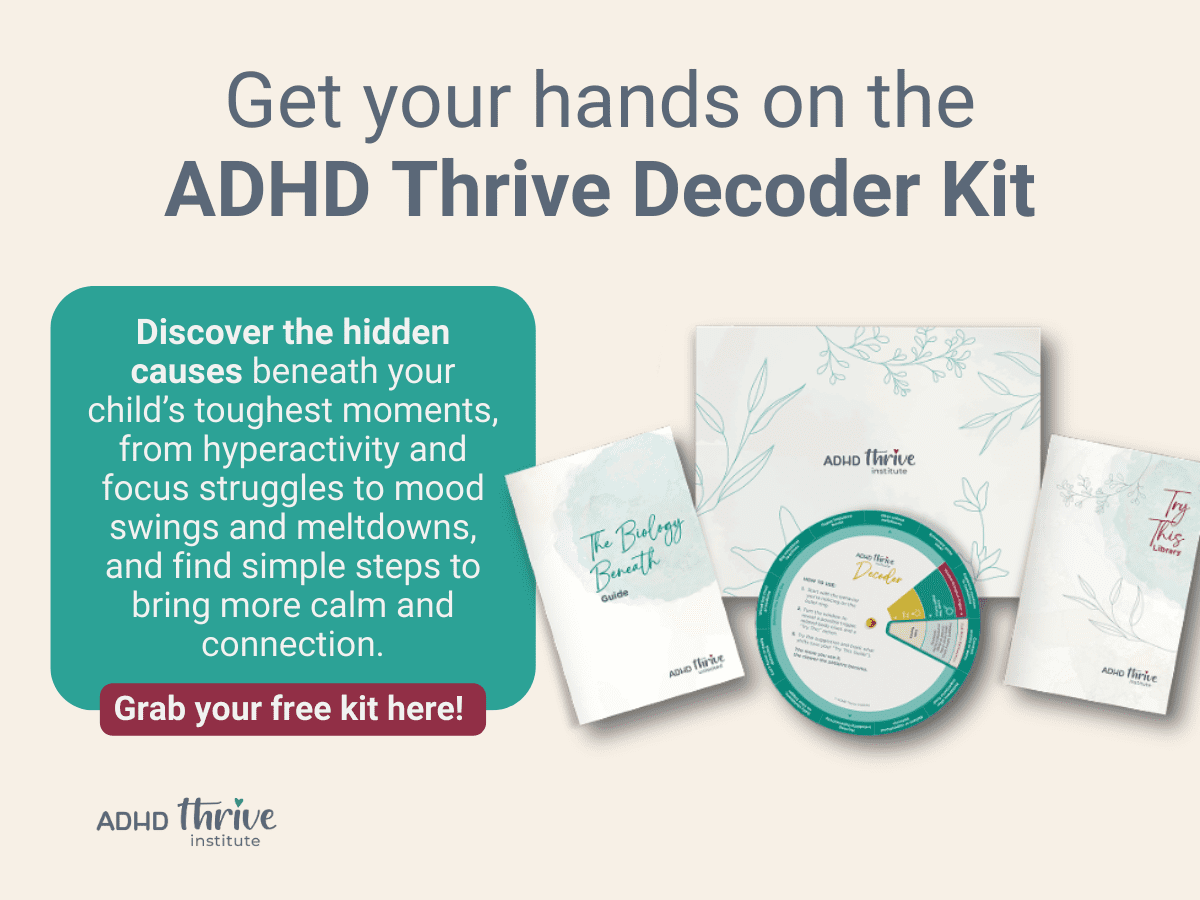
Inside the kit, you’ll find:
✔️ A physical Decoder Wheel that helps you pinpoint which of the five biological stressors is likely affecting your child
✔️ Quick guides to help you decode symptoms and connect the dots
✔️ “Try this today” action steps that are actually doable
The Decoder Kit is free — we just ask that you cover shipping — and we’ll send it straight to your doorstep.
If I’d had this when raspberries were quietly wrecking our week, I could’ve saved myself months of second-guessing and midnight Googling.
👉 Grab your free Decoder Kit here
Please note that at this time, shipping is available within the United States only.
Coming Up Next in the ADHD Biology Series
This post is Part 3 of our 5-part ADHD Biology Series.
Here’s a quick recap of what we’ve covered so far:
How unstable blood sugar can cause major emotional swings, especially in the morning and after school
Why gut inflammation disrupts brain chemistry and exacerbates ADHD symptoms
Part 3 (This Post)
Invisible food reactions and sensitivities that trigger delayed inflammation and dysregulation
Coming up next:
Part 4: Poor Detox
How your child’s body handles toxins (and what happens when it can’t)
Check back next week for this post, especially if your child deals with rigidity, tension, or seems stuck in constant fight-or-flight.
FAQs About Food Sensitivities and ADHD
Can food sensitivities cause ADHD symptoms even if my child has no tummy issues?
Yes. Many food reactions show up as behavior changes rather than digestive symptoms. Mood swings, anxiety, hyperactivity, and sleep disturbances are common signs.
What’s the difference between a food allergy and a food sensitivity?
A true food allergy (IgE reaction) causes an immediate reaction like hives or swelling and can be life-threatening. A food sensitivity (IgA or IgG), on the other hand, triggers a delayed immune response, is often subtle, and symptoms may not show up until later on. Read this post to learn more.
Should we eliminate gluten and dairy even if tests are negative?
While gluten and dairy are common triggers, testing helps determine whether they’re affecting your child (and how much). In my experience working with over 1600 children with ADHD, I always recommend gluten be removed from the diet, at least temporarily as the body heals.
What are the most common ADHD food triggers?
Some of the biggest culprits include:
- Gluten
- Dairy
- Soy
- Corn
- Artificial dyes (like Red 40)
- Preservatives (like sodium benzoate)
- Excessive amounts of refined sugar
- Even certain fruits, nuts, or eggs, depending on the child
To find out for sure, I recommend functional lab testing. Learn more about that here.
How long does it take to see improvement after removing a trigger food?
Some parents notice changes within days, while for others, it may take several weeks or even months. It depends on the child’s level of inflammation and whether multiple triggers are involved.
Resources:
Asbjornsdottir, B., Snorradottir, H., Andresdottir, E., Fasano, A., Lauth, B., Gudmundsson, L. S., Gottfredsson, M., Halldorsson, T. I., & Birgisdottir, B. E. (2020). Zonulin-Dependent Intestinal Permeability in Children Diagnosed with Mental Disorders: A Systematic Review and Meta-Analysis. Nutrients, 12(7), 1982. https://doi.org/10.3390/nu12071982

Checa-Ros, A., Jeréz-Calero, A., Molina-Carballo, A., Campoy, C., & Muñoz-Hoyos, A. (2021). Current Evidence on the Role of the Gut Microbiome in ADHD Pathophysiology and Therapeutic Implications. Nutrients, 13(1), 249. https://doi.org/10.3390/nu13010249

Lewis, N., Lagopoulos, J., & Villani, A. (2025). Gut–Brain Inflammatory Pathways in Attention-Deficit/Hyperactivity Disorder: The Role and Therapeutic Potential of Diet. Metabolites, 15(5), 335. https://doi.org/10.3390/metabo15050335

Lewis, N., Villani, A., & Lagopoulos, J. (2025). Gut dysbiosis as a driver of neuroinflammation in attention-deficit/hyperactivity disorder: A review of current evidence. Neuroscience, 569, 298-321. https://doi.org/10.1016/j.neuroscience.2025.01.031