
“Why is my child’s ADHD worse all of the sudden?”
If you’ve asked yourself this question, you’re in the right place.
Nothing major changed. You didn’t overhaul routines, change your child’s diet, or loosen boundaries. And yet…
Your child seems more impulsive, more emotional, or more sensitive than usual.
If this sounds familiar, you’re not imagining it.
Spring changes a lot more than the weather, and for kids with ADHD, those shifts can add up fast.
In this post, we’ll explore why some kids with ADHD seem to get worse during the Spring months. We’ll also take a look at what you can do to help.
4 Reasons Spring Can Make ADHD Symptoms Worse
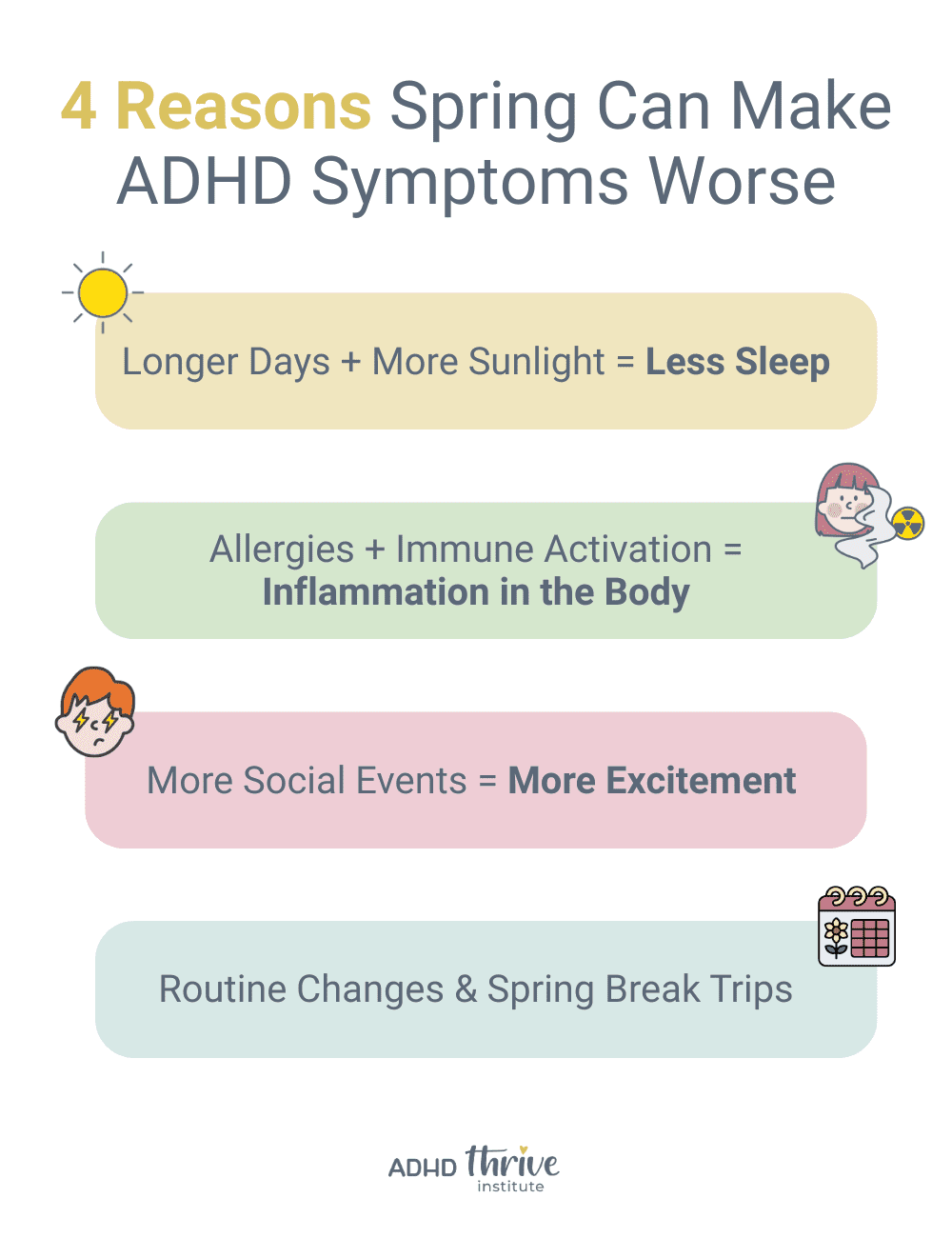
Spring feels light and fresh on the outside, but biologically, it’s a season of adjustment. There are longer days and more sunlight (think Daylight Savings Time), more social events (Easter dinners, anyone?), potential travel (hello, Spring Break trips), less predictable schedules, and more pollen and other allergens in the air.
For a regulated nervous system, these things are all manageable, but for an ADHD brain (which is already working harder to stay balanced) these changes can sometimes feel insurmountable.
Let’s break down each of these changes and why they are so tricky for children with ADHD:
- Longer Days + More Sunlight = Less Sleep
As the days get longer, your child’s brain is exposed to more light later in the evening. Light directly affects melatonin, the hormone that signals sleep. When sunset shifts later:
- Melatonin release shifts later.
- Bedtime resistance increases.
- Falling asleep takes longer.
And then we layer in Daylight Saving Time. Even a one-hour clock shift can disrupt a child’s circadian rhythm for days (sometimes weeks). Their body clock doesn’t instantly adjust just because the clock on the wall changed. That lost hour often shows up as:
- Harder bedtimes
- Earlier wake-ups
- Restless sleep
- Increased irritability
Even if your child technically goes to bed at the same time, their body may not be ready to sleep.
Kids with ADHD are especially sensitive to sleep changes. Research consistently shows that sleep disruption amplifies ADHD symptoms. Even 30–45 minutes less sleep can lead to more impulsivity, more emotional reactivity, harder mornings, and lower frustration tolerance.
What looks like “behavior getting worse” is often a tired brain trying to cope.
- Allergies + Immune Activation = Inflammation in the Body
Spring also brings pollen, mold spores, and environmental allergens. Even mild allergies can disrupt sleep, increase inflammation in the body, raise histamine levels, increase brain fog, or amplify irritability.
Histamine is stimulating to the brain. Inflammation affects dopamine regulation. For kids with ADHD — whose regulation systems are already sensitive — this immune activation can tip the balance.
Even if your child doesn’t have dramatic allergy symptoms, subtle congestion, itchy eyes, or restless sleep can quietly increase nervous system load, which can lead to increased ADHD symptoms.
- More Social Events = More Excitement
Spring means more life outside the house: more outdoor play, school events, field days, assemblies, Easter parties, egg hunts, and extended family gatherings.
Easter, in particular, brings a perfect storm of stimulation.
There’s the anticipation buildup in the days leading up to it, the excitement of egg hunts (which often mix competition, noise, and sensory overload), church services or community events with longer sitting times, family meals in busy, unfamiliar environments, cousins, sugar and artificial food dyes, new toys, and late nights.
Even if it’s all “fun,” it’s still a lot.
Excitement increases dopamine, and dopamine spikes feel great in the moment. But what goes up fast often comes down hard.
After a highly stimulating day, many ADHD kids experience what looks like emotional crashes, irritability, tearfulness, or explosive reactions over small triggers.
And if candy is part of the day, blood sugar swings can layer on top of the excitement (I talk more about that in this post: How to Have an Eggscellent Easter With Your Child With ADHD. Or you can learn more about sugar and ADHD here.)
It’s not defiance. It’s not a “bad attitude.” It’s a nervous system recalibrating after overload.
For kids with ADHD, big, exciting days like Easter can quietly push the system past its threshold.
- Routine Changes & Spring Break Trips
Spring also disrupts predictability. There are Spring break trips, holiday weekends, school events, and different after-school rhythms. ADHD brains thrive on structure.
When daily anchors shift, even slightly, regulation becomes harder. Less predictability can lead to more anxiety, control-seeking behavior, resistance, or emotional volatility.
For older children, this time of year often brings standardized testing, academic assessments, end-of-year projects, and classroom schedule changes. There may be:
- Longer periods of sitting
- Increased performance pressure
- More cognitive load
- Less movement
- More mental fatigue
Even if your child isn’t talking about stress, their nervous system feels it. An ADHD brain already works harder to maintain focus and regulation. Add testing pressure and routine shifts on top of that, and the system can become overloaded more quickly.
And because these changes happen gradually, parents often don’t realize how much has shifted until behavior gets worse.
Why These Changes Hits ADHD Brains Harder
ADHD isn’t just about attention. It’s also about regulation. The ADHD nervous system is more sensitive to:
- Sleep loss
- Stimulation spikes
- Immune stress
- Routine disruption
- Environmental changes
Spring brings all of those at once, so it makes sense that many kids with ADHD might struggle more in the spring than in other seasons of the year. So how do you know if what you’re seeing is a seasonal shift, not your child backsliding?
Signs It’s a Seasonal Regulation Shift (Not Regression)
Spring-related shifts usually have a few defining features. They tend to:
- Show up alongside longer days, schedule changes, travel, or holidays.
- Affect sleep and mood at the same time.
- Feel sudden rather than gradual.
- Improve when structure and sleep are tightened again.
You might notice:
☑️ Bedtime drifting later right after Daylight Savings or lighter evenings
☑️ Harder mornings that coincide with shorter or more restless sleep
☑️ Emotional sensitivity that spikes after busy weekends, travel, or events
☑️ Bigger reactions following highly stimulating days (like Easter gatherings)
☑️ More impulsivity during testing weeks or schedule changes
☑️ Increased sensory overwhelm in crowded or noisy spring environments
☑️ Extra clinginess during transitions or unfamiliar routines
What makes this seasonal is that the behavior is responsive to environmental shifts. It’s not a steady downward trend but rather a nervous system reacting to increased input.
When sleep stabilizes, routines anchor, and stimulation settles, the symptoms usually soften again. Regression tends to look more persistent and less tied to context.
What Actually Helps During Spring Shifts

If spring increases nervous system load, the solution is stabilization.
We can’t stop the sun from setting later. We can’t cancel school events. We probably don’t want to skip Easter entirely. But we can lower the overall regulation burden.
Here’s what helps most:
- Protect Sleep Like It’s Medicine
Sleep is the first domino. Keep bedtime consistent, even if your child says they’re not tired. Dim lights earlier to support melatonin. Reduce evening screen exposure. Use blackout curtains if needed. Add a longer wind-down buffer during DST transitions. Even small sleep protection can reduce emotional reactivity dramatically.
- Anchor the Day With Predictable Points
When schedules drift, anchors matter more than ever. Pick 2–3 non-negotiables in your day that stay steady:
- Morning routine
- After-school snack and decompression time
- Consistent dinner timing
- Same bedtime wind-down pattern
Predictability calms the ADHD brain. It lowers anxiety and reduces control-seeking behavior.
- Pre-Regulate Before Big Events
Before Easter gatherings, school events, or busy weekends:
- Add movement earlier in the day.
- Prioritize protein at meals.
- Build in quiet time before leaving the house.
- Set expectations clearly and calmly.
Going in regulated reduces the crash later. For Easter celebrations, in particular, I would also recommend avoiding foods that can trigger or exacerbate ADHD symptoms (like gluten, dairy, and artificial colors).
- Schedule Decompression After Excitement
This is the piece most families miss. After highly stimulating days:
- Keep the next morning slower.
- Avoid over scheduling.
- Offer quiet play or solo time.
- Lower expectations.
Dopamine crashes need recovery time. If we expect “normal” behavior immediately after big stimulation, we often get meltdowns instead.
- Support the Body
Spring support can also include:
- Managing allergy symptoms if present.
- Staying hydrated.
- Maintaining balanced meals (especially protein in the morning, more whole foods, and reduced inflammatory foods).
- Ensuring regular bowel movements (these help with detox and reducing inflammation).
- Getting outside earlier in the day for natural light exposure.
These are small shifts that support the nervous system. When we stabilize sleep, protect routine anchors, and allow recovery after stimulation, most spring spikes soften.
Remember, you’re not parenting a “worse” child. You’re parenting a sensitive nervous system in a high-input season. And that’s something we can work with.
FAQs About ADHD and Spring Behavior Changes
Can seasons affect ADHD symptoms?
Yes. Seasonal changes can influence sleep, immune activity, light exposure, and routine, all of which affect nervous system regulation. Because ADHD brains are more sensitive to environmental shifts, symptoms may temporarily intensify during seasonal transitions like spring.
Does Daylight Saving Time make ADHD worse?
It can. Even a one-hour clock change can disrupt circadian rhythm, delay melatonin release, and reduce total sleep time. Since sleep directly impacts emotional regulation and impulse control, ADHD symptoms may feel amplified after DST shifts.
Can allergies make ADHD symptoms worse?
Yes. Allergies increase inflammation and histamine in the body. Histamine is stimulating to the brain and can interfere with sleep. Poor sleep and inflammation can both increase emotional reactivity and impulsivity in children with ADHD.
Why does my ADHD child seem worse after holidays like Easter?
Big events increase dopamine and stimulation. After the excitement passes, many children experience an emotional “crash.” This can look like irritability, meltdowns, or clinginess. It’s often nervous system recalibration rather than defiance. Add in the extra element of excessive amounts of sugars and artificial colors, and you have a recipe for dysregulation.
How long do seasonal ADHD spikes last?
Seasonal shifts are usually temporary. When sleep stabilizes, routines settle, and stimulation decreases, symptoms often improve. If behavior changes persist beyond the transition period, it may be worth looking at additional stressors.
Resources:
Bijlenga, D., Vollebregt, M. A., Kooij, J. J. S., & Arns, M. (2019). The role of the circadian system in the etiology and pathophysiology of ADHD: Time to redefine ADHD? European Psychiatry, 57, 19–25. https://doi.org/10.1016/j.eurpsy.2019.01.014

Buske-Kirschbaum, A., Geiben, A., & Hellhammer, D. (2001). Psychobiological aspects of atopic dermatitis: An overview. Psychoneuroendocrinology, 26(7), 665–677.

Chen, M. H., Su, T. P., Chen, Y. S., Hsu, J. W., Huang, K. L., Chang, W. H., … & Bai, Y. M. (2013). Allergic diseases and attention-deficit/hyperactivity disorder: A nationwide population-based study. Journal of Child Psychology and Psychiatry, 54(12), 1343–1350. https://doi.org/10.1111/jcpp.12134

Gruber, R., Fontil, L., Bergmame, L., Wiebe, S. T., Amsel, R., Frenette, S., & Carrier, J. (2012). Contributions of circadian tendencies and behavioral problems to sleep onset problems of children with ADHD. BMC Psychiatry, 12, 212. https://doi.org/10.1186/1471-244X-12-212

Hoza, B., Pelham, W. E., Dobbs, J., Owens, J. S., & Pillow, D. R. (2002). Do boys with attention-deficit/hyperactivity disorder have positive illusory self-concepts? Journal of Abnormal Psychology, 111(2), 268–278.

Komada, Y., Okajima, I., & Inoue, Y. (2020). Seasonal variation in sleep problems among children: Association with circadian and environmental factors. Chronobiology International, 37(10), 1469–1476.

Medina, A. M., Lederer, C. R., & Kennedy, R. (2021). Daylight saving time and sleep: A systematic review. Sleep Medicine Reviews, 56, 101408. https://doi.org/10.1016/j.smrv.2020.101408

McHill, A. W., & Wright, K. P. (2017). Role of sleep and circadian disruption on energy expenditure and in metabolic health. Proceedings of the Nutrition Society, 76(3), 430–438.

Murray, D. W., et al. (2016). School services for children with ADHD: Current status and recommendations. School Psychology Review, 45(3), 315–329.

Oades, R. D., Dauvermann, M. R., Schimmelmann, B. G., Schwarz, M. J., & Myint, A. M. (2010). Attention-deficit hyperactivity disorder (ADHD) and glial integrity: Associations of S100B and cytokine levels in serum of children with ADHD. Journal of Child Psychology and Psychiatry, 51(5), 611–621.

Owens, J. A. (2005). The ADHD and sleep conundrum: A review. Journal of Developmental & Behavioral Pediatrics, 26(4), 312–322.

Posner, J., Polanczyk, G. V., & Sonuga‐Barke, E. (2020). Attention-deficit hyperactivity disorder. The Lancet, 395(10222), 450–462.

Shaw, P., Stringaris, A., Nigg, J., & Leibenluft, E. (2014). Emotion dysregulation in attention deficit hyperactivity disorder. American Journal of Psychiatry, 171(3), 276–293.

Vogel SWN, Ten Have ML, Bijlenga D, de Graaf R, Beekman ATF, Kooij JJS. Seasonal Variations in the Severity of ADHD Symptoms in the Dutch General Population. J Atten Disord. 2019 Jul;23(9):924-930. doi: 10.1177/1087054716649663. Epub 2016 May 19. PMID: 27199240.

Volkow, N. D., Wang, G. J., Kollins, S. H., Wigal, T. L., Newcorn, J. H., Telang, F., … & Swanson, J. M. (2009). Evaluating dopamine reward pathway in ADHD: Clinical implications. JAMA, 302(10), 1084–1091.

Volkow, N. D., & Swanson, J. M. (2013). Clinical practice: Adult attention deficit–hyperactivity disorder. New England Journal of Medicine, 369(20), 1935–1944.

Yang, C. M., Spielman, A. J., & D’Ambrosio, P. (2001). Time course of sleep inertia in normal subjects. Sleep, 24(4), 436–443.