

“Put your shoes on.”
“Why?”
“Because we’re leaving.”
“But I don’t want to leave yet.”
“We have to go.”
“But why do we have to go now?”
Suddenly, what should have been a five-second request turns into a ten-minute debate.
If you’re raising a child with ADHD, this scenario probably feels painfully familiar. It can leave parents wondering: Why does my ADHD child argue about everything? Are they just being difficult? Do kids with ADHD actually enjoy arguing?
The reality is, most ADHD kids are not trying to be oppositional. In fact, the constant arguing many parents experience is often the result of how the ADHD brain processes frustration, transitions, control, and emotional regulation.
Let’s break down why ADHD kids tend to argue more than their neurotypical peers, and what you can do to help stop the arguing in your home.
Why ADHD Kids Tend to Argue More Than Other Kids
When parents talk to me about their relationship with their ADHD child, one phrase comes up again and again: “It feels like everything turns into an argument.” While that experience is very real, it’s important to understand something crucial:
Most ADHD kids are not arguing because they’re trying to be defiant or disrespectful.
Here are some of the most common reasons ADHD kids tend to argue more than their neurotypical peers.
- Executive Function Challenges
Executive function is the brain’s management system. It helps us regulate behavior and emotions, focus our attention, plan and organize things, control our impulses, shift attention, stop what we’re doing, transition to a new task, adapt to changes, and follow multi-step directions.
Executive functioning (EF) skills are core cognitive processes often delayed or impaired in individuals with ADHD.
When a parent says something like:
“Turn off the tablet.”
“Put your shoes on.”
“Start your homework.”
The request can feel like an abrupt interruption. Their brain is deeply engaged in one activity and suddenly has to stop, change plans, and start something new. That transition can feel uncomfortable or even stressful. Arguing sometimes becomes a way to delay the transition while their brain catches up.
- Cognitive Rigidity
One executive functioning skill that many kids with ADHD lack is cognitive flexibility, or the ability to shift thinking when plans change.
When a child already has a plan in their mind (for example, “I’m going to keep playing this game”), being told to do something different can feel like a sudden derailment. Instead of adapting quickly, their brain may push back.
This can look like:
- debating your request
- challenging your reasoning
- insisting on their plan
- negotiating endlessly
From the outside it looks like stubbornness, but often it’s simply a brain that struggles with cognitive rigidity.
- Dopamine & Stimulation Seeking
The ADHD brain runs on lower levels of dopamine, a neurotransmitter involved in motivation, focus, and reward. Because of this, ADHD brains are naturally drawn to stimulation and novelty.
Interestingly, arguing can provide exactly that. Debating, challenging, and questioning creates engagement, mental stimulation, and emotional intensity. In other words, it activates the brain.
This doesn’t mean your child wants to fight, but it does mean that a back-and-forth argument can sometimes feel more stimulating than simply following a direction.
This is also why some ADHD kids seem to challenge parents more when they’re bored or under-stimulated.
- Emotional Dysregulation & Low Frustration Tolerance
Finally, ADHD often affects the brain’s ability to regulate emotions. Small frustrations can feel much bigger to an ADHD child. When something doesn’t go the way they expected — whether it’s stopping a game, changing plans, or hearing “no” — their nervous system may react quickly and intensely.
Arguing can become an outlet for that frustration. Instead of calmly accepting the change, their brain moves into pushback mode.
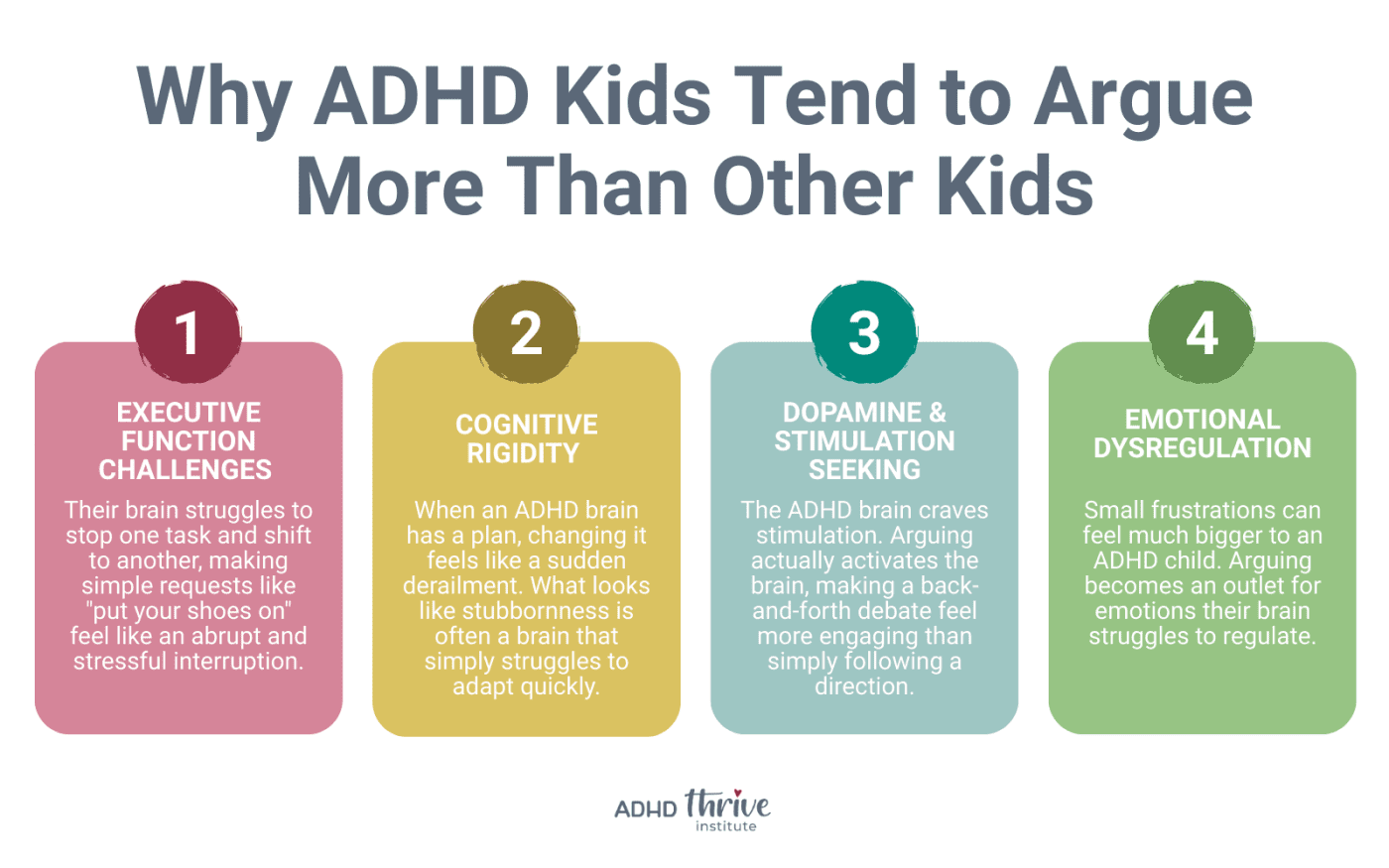
When you look at these pieces together (executive function challenges, cognitive rigidity, stimulation seeking, and emotional dysregulation), it becomes much easier to see why arguing shows up so frequently in ADHD households.
Your child isn’t necessarily trying to challenge your authority. More often, their brain is simply struggling to shift, regulate, and adapt in the moment.
Understanding that difference is the first step toward reducing the constant power struggles many families experience.
The Power Struggle Trap
Once arguing becomes a pattern, many families unknowingly fall into what psychologists often call the power struggle loop.
It usually looks something like this: Parent makes a request → Child argues → Parent pushes harder → Child escalates.
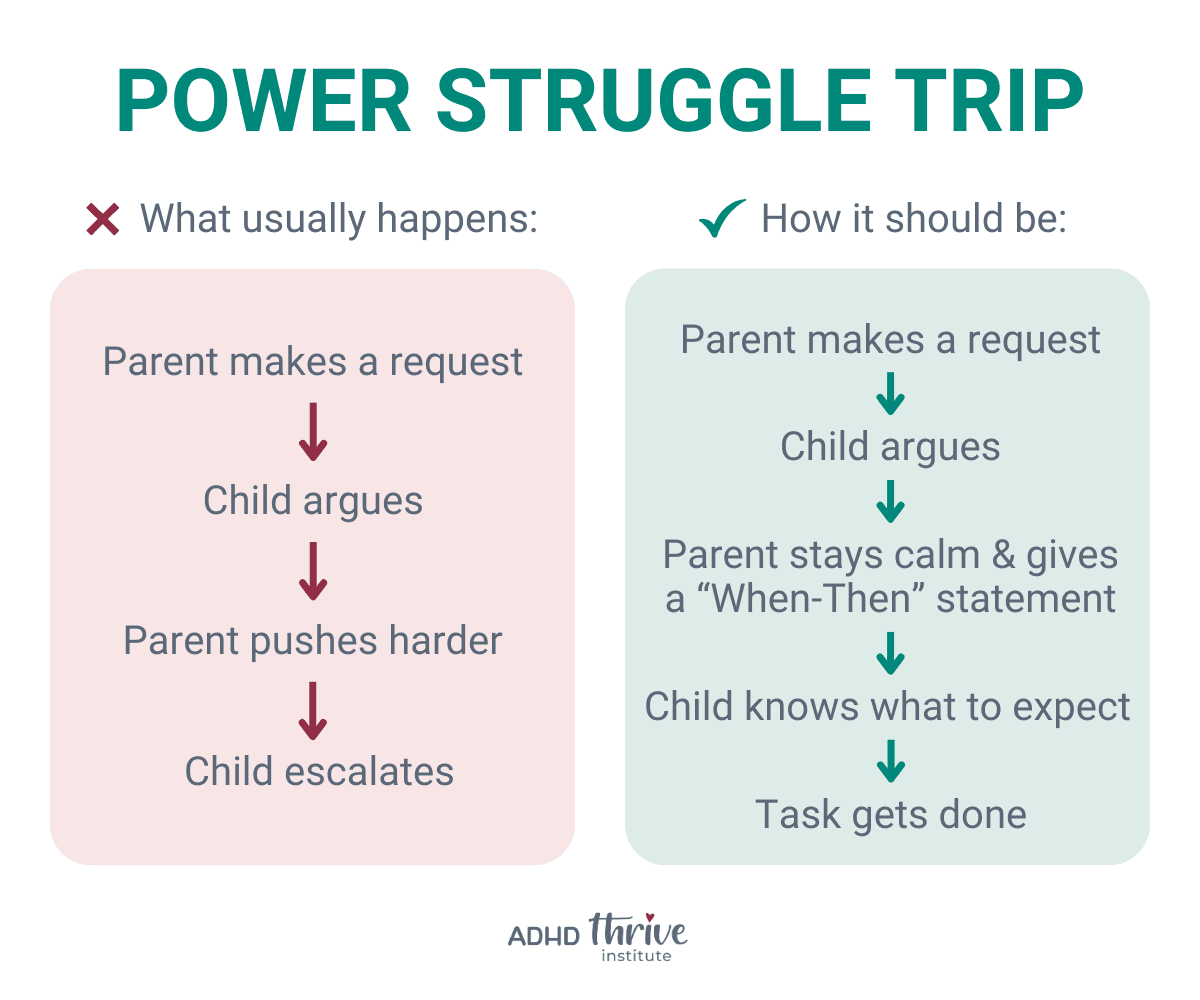
This pattern is incredibly common in households with ADHD because both the parent and the child are reacting to the situation in completely understandable ways.
When a child pushes back, the parent naturally feels the need to reassert authority and gain cooperation, so the parent increases pressure.
But for a child with ADHD, that added pressure often triggers more resistance. Before long, both people are locked in a battle neither of them intended to start. Once this cycle repeats often enough, arguing can become the default interaction pattern.
The child learns that every request leads to a debate. The parent begins expecting pushback before the conversation even begins.
Understanding this pattern is important, because the goal isn’t to “win” the argument. The goal is to break the cycle before it gains momentum.
One Strategy That Can Reduce Arguing Quickly
One simple strategy that can break this power struggle cycle is to remove the debate altogether.
This involves two key shifts:
- Use clear When-Then statements when giving instructions.
- Avoid engaging in a back-and-forth argument after the instruction is given. (Or, in other words, don’t argue back.)
Here’s what that looks like in practice. Instead of saying, “Brush your teeth now.” You might say instead, “When you have brushed your teeth, then you can play a video game.”
When possible, it helps if the “Then” part of the statement leads to something your child enjoys or is motivated by.
ADHD brains run on dopamine, which is the brain chemical involved in motivation and reward. When the brain can see something positive on the other side of a task, it’s often easier to get started.
For example:
“When your homework is finished, then you can go outside,” or, “When your shoes are on, then we can leave for the park.”
In these cases, the preferred activity helps the brain move toward the task instead of resisting it.
But of course, life doesn’t always work that way. Sometimes the “Then” is simply the next thing that has to happen, not a special reward.
For example:
“When your shoes are on, then we will get in the car for school,” or, “When the tablet is off, then we will start dinner.”
In these situations, the “Then” still works because it provides structure and predictability. Your child’s brain knows exactly what comes next. The key is not that the “Then” must always be exciting. The key is that the sequence stays clear, calm, and consistent.
Over time, that predictability helps reduce the urge to argue because the conversation is no longer about whether the task will happen (only about when it will happen).
If your child pushes back against your When-Then statement, you don’t argue back, no matter what. Arguing requires two people. By removing yourself from the argument, you stop the loop completely.
Why This Works for ADHD Brains
As already mentioned, ADHD brains tend to seek stimulation and novelty. Emotional interactions (especially debates) can be surprisingly stimulating.
When a parent begins explaining, negotiating, defending the rule, or responding emotionally, the child’s brain receives more engagement and more stimulation, which can unintentionally fuel the argument.
In other words, the debate itself becomes rewarding.
By keeping instructions brief, predictable, and consistent, you remove the stimulation that keeps the argument going. At the same time, the When-Then structure provides something ADHD brains respond well to: clear sequencing.
Instead of feeling like an arbitrary demand, the instruction becomes a simple order of events. “When this happens… then this happens next.” This reduces uncertainty and gives the brain a clearer path forward.
Over time, when children realize that arguing no longer leads to a prolonged discussion or negotiation, the incentive to argue often decreases as well.
The goal isn’t to ignore your child’s feelings or shut down communication. There will always be space to talk things through later. But in the moment, keeping requests clear, calm, and non-negotiable can dramatically reduce the power struggle loop that many ADHD families experience.
Please note, however, that sometimes, things get worse before they get better. That’s because when a child sees that you are no longer arguing with them and giving them the stimulation you have previously, they might push harder at first. Don’t lose heart if this happens. Continue your plan to not argue back and use When-Then statements, and eventually, things will improve.
When Arguing Signals Something Deeper
While arguing in ADHD kids is often driven by the factors already mentioned, there are times when an increase in argumentative behavior can signal something deeper happening in the body.
In the ADHD Thrive framework, we often remind parents that behavior is communication. When a child’s nervous system is under strain, that stress can show up in many different ways, including increased arguing, irritability, or resistance.
In our work with over 1700 families, we consistently see that certain biological stressors can amplify ADHD behaviors, including arguing and emotional reactivity. Some of the most common include:
- Blood sugar swings, which can make the brain more reactive and impulsive
- Gut inflammation, which can affect neurotransmitter production and mood regulation
- Food sensitivities, which may trigger behavioral and emotional changes hours or even days later
- Poor detoxification pathways, which can increase the body’s toxic burden
- Nutrient deficiencies, which can affect dopamine production, focus, and emotional control
When the body is under this kind of pressure, the nervous system often becomes more reactive, and arguing can increase as a result.
So, how can you know which biological stressor your child is battling? Enter the ADHD Thrive Decoder Kit.

The Decoder Kit is a free* tool that helps parents move beyond simply reacting to behaviors and instead decode what might be driving them.
Inside the kit, you’ll find a simple visual Decoder Wheel that walks you through the five most common biological stressors we see in children with ADHD.
Using the wheel and the accompanying guides, you can begin identifying which biological stressor may be contributing to your child’s behaviors and then implement small, practical steps.
Instead of guessing or trying random strategies, the Decoder Kit helps you understand where to start.
*The ADHD Decoder Kit is free. You cover shipping; we cover the rest. At this time, we are only able to ship within the United States.
Frequently Asked Questions about Arguing and ADHD:
Why do ADHD kids argue so much?
Children with ADHD often argue more because their brains process transitions, frustration, and emotional regulation differently. Executive function challenges can make it difficult to stop what they’re doing or switch tasks quickly. Conflict can be stimulating and engaging for some ADHD brains, and that may unintentionally make arguing more likely. In many cases, the behavior isn’t intentional defiance, but instead a response to feeling overwhelmed, interrupted, or frustrated.
Do kids with ADHD like to argue?
Most children with ADHD don’t actually like arguing. However, arguments can create stimulation and engagement that ADHD brains naturally seek. Because debating can delay transitions or difficult tasks, it may also become a habit over time. What looks like enjoyment of arguing is often a child’s brain responding to stress, boredom, or difficulty shifting attention.
Is arguing a symptom of ADHD?
Arguing itself is not listed as a formal ADHD diagnostic symptom, but it is commonly associated with ADHD-related challenges such as emotional dysregulation, impulsivity, and difficulty transitioning between tasks. These underlying difficulties can lead to more frequent disagreements, debates, or pushback compared to neurotypical peers.
How do you stop arguing with an ADHD child?
Reducing arguments with an ADHD child often involves changing the interaction pattern rather than trying to “win” the argument. Many experts recommend giving clear, brief instructions and avoiding back-and-forth debates. Strategies like using When–Then statements, keeping expectations predictable, and remaining calm can help break the power struggle cycle.
Is ADHD related to oppositional defiant disorder (ODD)?
ADHD and oppositional defiant disorder are separate conditions, but they sometimes occur together. Some children with ADHD may also show symptoms of ODD, which include persistent defiance, hostility, or arguing with authority figures. However, many ADHD children who argue frequently do not have ODD. The behavior may instead be related to executive function challenges or emotional dysregulation.
Why does my ADHD child challenge everything I say?
Many ADHD children challenge instructions because they struggle with cognitive flexibility and impulse control. When a plan changes or a preferred activity must stop, the brain may instinctively push back. This isn’t usually about disrespect, but is instead the brain’s attempt to regain control of a difficult transition.
Can diet or health issues make ADHD arguing worse?
Yes. Biological factors such as blood sugar swings, gut inflammation, food sensitivities, detoxification challenges, and nutrient deficiencies might affect mood regulation and impulse control in some children. When the nervous system is under additional stress, behaviors like irritability, arguing, or emotional outbursts may increase.
Resources:
Groves NB, Wells EL, Soto EF, Marsh CL, Jaisle EM, Harvey TK, Kofler MJ. Executive Functioning and Emotion Regulation in Children with and without ADHD. Res Child Adolesc Psychopathol. 2022 Jun;50(6):721-735. doi: 10.1007/s10802-021-00883-0. Epub 2021 Nov 11. PMID: 34762251; PMCID: PMC9091051.

Paiva GCC, de Paula JJ, Costa DS, Alvim-Soares A, Santos DAFE, Jales JS, Romano-Silva MA, de Miranda DM. Parent training for disruptive behavior symptoms in attention deficit hyperactivity disorder: a randomized clinical trial. Front Psychol. 2024 Feb 16;15:1293244. doi: 10.3389/fpsyg.2024.1293244. PMID: 38434955; PMCID: PMC10906662.