
Most parents assume their child could eat a few more vegetables, but what many don’t realize is just how widespread this problem actually is.
According to CDC data¹, in a 2021 survey of 18,386 individuals, nearly 1 in 3 children did not eat a daily fruit, and about 1 in 2 didn’t eat a daily vegetable. Equally alarming, this study also found that 57.1% drank a sugar-sweetened beverage at least once during the previous week.
What this data suggests (and I can personally attest to in my own research and work with over 1600 families) is that kids are eating far too few fruits and vegetables and far too much sugar!
Fruits and vegetables aren’t just “nice to have” foods. They provide key nutrients that support brain function, gut health, and overall regulation (things that are especially important for kids with ADHD).
In this article, we’re going to walk through:
- what the research actually shows about kids and fruit and vegetable intake
- why so many children struggle to eat them
- how this connects to ADHD symptoms
- and simple, practical ways to help your child eat more (without turning every meal into a battle)
Because it is possible to support your child’s nutrition in a way that feels doable and actually makes a difference.
What the Research Actually Shows
The CDC used data from the 2021 National Survey of Children’s Health, a nationally representative survey that asks a parent or adult caregiver about a child’s health and behaviors. The final analytic sample included 18,386 children ages 1–5.
How the research was done
The survey asked how often children consumed fruits, vegetables, and sugar-sweetened beverages during the previous week.
Main findings
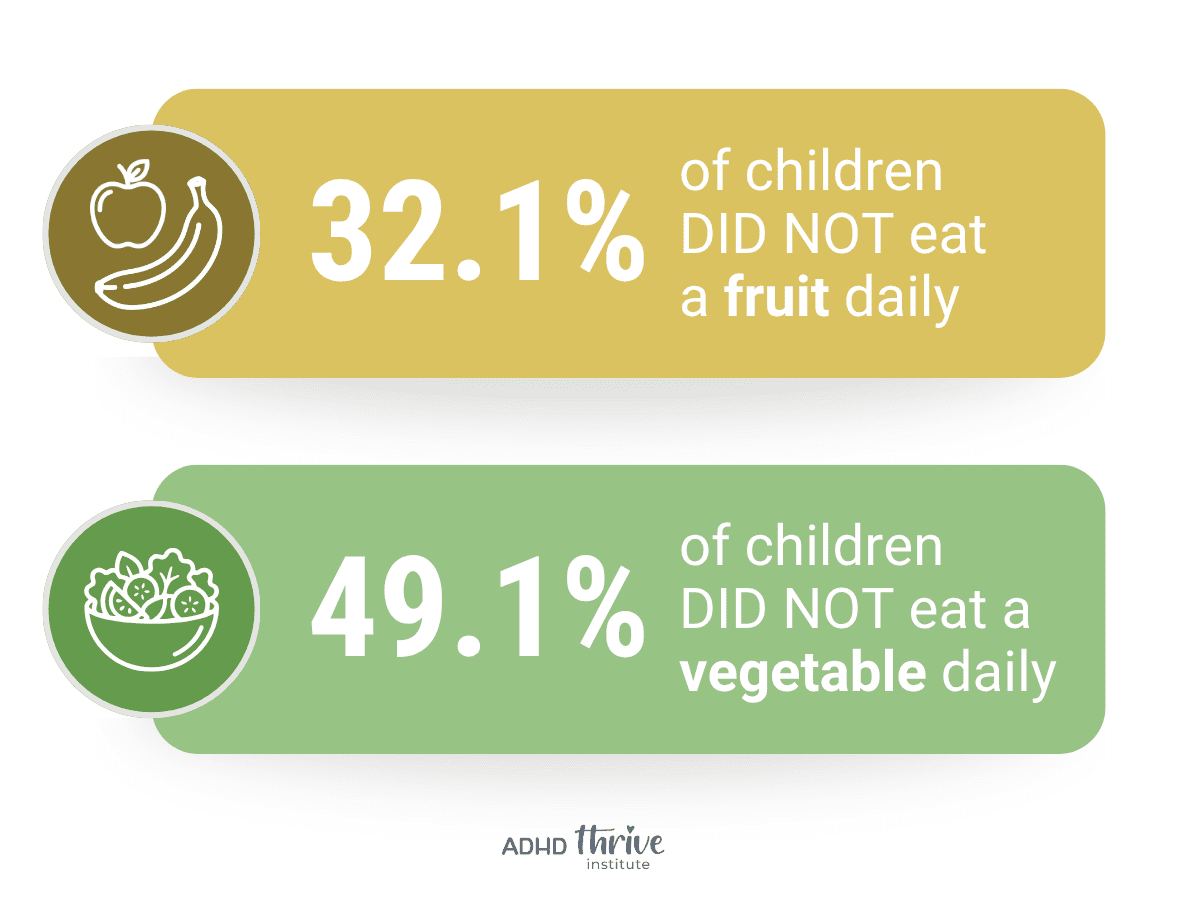
This paints a pretty clear picture: Fruits and vegetables are not a regular part of many children’s diets.
When you layer in the high intake of sugar-sweetened beverages and processed foods, it helps explain why so many parents feel like their child’s diet is hard to balance.
The results of this survey varied significantly by ethnicity, by state, and by whether or not a child lived with lower food sufficiency or not. For example, the share of children who did not eat a daily vegetable ranged from 30.4% in Vermont to 64.3% in Louisiana, and sugary beverage intake ranged from 38.8% in Maine to 79.3% in Mississippi.
Limits of the research
The authors note several limitations: diet was reported by an adult caregiver, the study measured frequency rather than amount, the survey was only in English and Spanish, and it reflected intake during just the prior week rather than usual intake. As a result, the findings are useful for population patterns, but not for judging each child’s exact diet.
The pattern that emerged, however, was clear – kids in the United States are definitely not eating enough whole foods, fruits, and vegetables.
Why This Matters for ADHD Kids
At first glance, this might feel like a general nutrition issue, but it goes deeper than that. Fruits and vegetables provide essential nutrients that support:
- brain function
- gut health
- blood sugar stability
- inflammation regulation
These systems are all connected, and they play a direct role in how a child feels and functions day to day.
For kids with ADHD, this becomes even more important, because when these systems are out of balance, it can show up as:
- difficulty focusing
- more emotional ups and downs
- lower frustration tolerance
- inconsistent energy
It’s important to be clear here: I’m NOT saying diet causes ADHD, but it can absolutely act as an amplifier. Additionally, I have seen many children whose ADHD symptoms decreased significantly (or even disappeared altogether) as a result of dietary changes and other natural strategies.
The reason for this is because nutrition can either support the brain or make things harder. We want to use every resource at our disposal (including nutrition) to make things easier and to support the brain and body.
Why Kids Don’t Eat Fruits and Vegetables
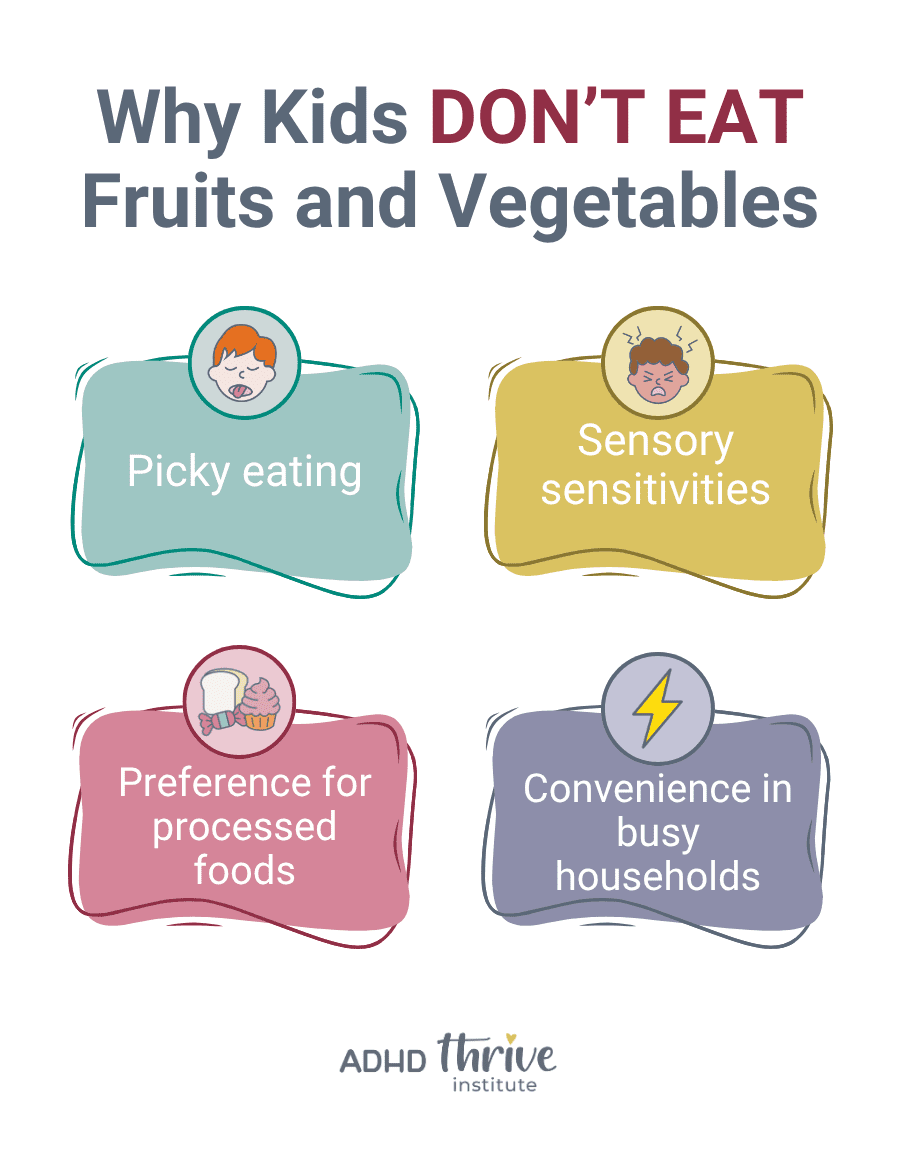
There are a lot of reasons kids avoid fruits and veggies. Some of the biggest ones include:
- Picky eating
- Sensory sensitivities (texture, smell, appearance)
- Preference for processed foods (did you know that processed foods are designed to be addictive? They are! It’s no wonder our kids prefer them over something that hasn’t had these addictive chemicals added.)
- Convenience in busy households
For kids with ADHD, there are a couple of additional layers. Many ADHD kids are more sensitive to textures and flavors, which can make fruits and vegetables harder to tolerate. At the same time, their brains are often seeking dopamine, which makes highly processed, sugary, or salty foods more appealing and rewarding.
For these reasons, when a child consistently chooses those foods over fruits and vegetables, it’s not just about preference. It’s about how their brain is wired to respond.
The Mistake Most Parents Make
When parents realize their child isn’t eating enough fruits and vegetables, the natural reaction is to try to fix it—fast.
That usually looks like:
- forcing (“just take a bite”)
- bribing (“if you eat this, you get dessert”)
- or hiding everything in other foods
While these strategies can work in the short term, they often backfire over time. Why? Because they don’t actually help a child become more comfortable with those foods. Instead, they can:
- increase resistance
- create negative associations with certain foods
- turn mealtimes into a power struggle
A child who feels pressured or controlled around food is actually less likely to try new things willingly, and when everything is hidden, they don’t get the exposure needed to eventually accept those foods on their own.
So while it makes sense why parents go this route, it usually leads to more frustration, not less.
Remember, the goal isn’t to force vegetables in. It’s to help your child gradually become more open to them in a way that feels low-pressure and sustainable.
How to Help Your Child Eat More Fruits and Vegetables
‘ \
So if forcing, bribing, and hiding foods aren’t the answer, what actually works?
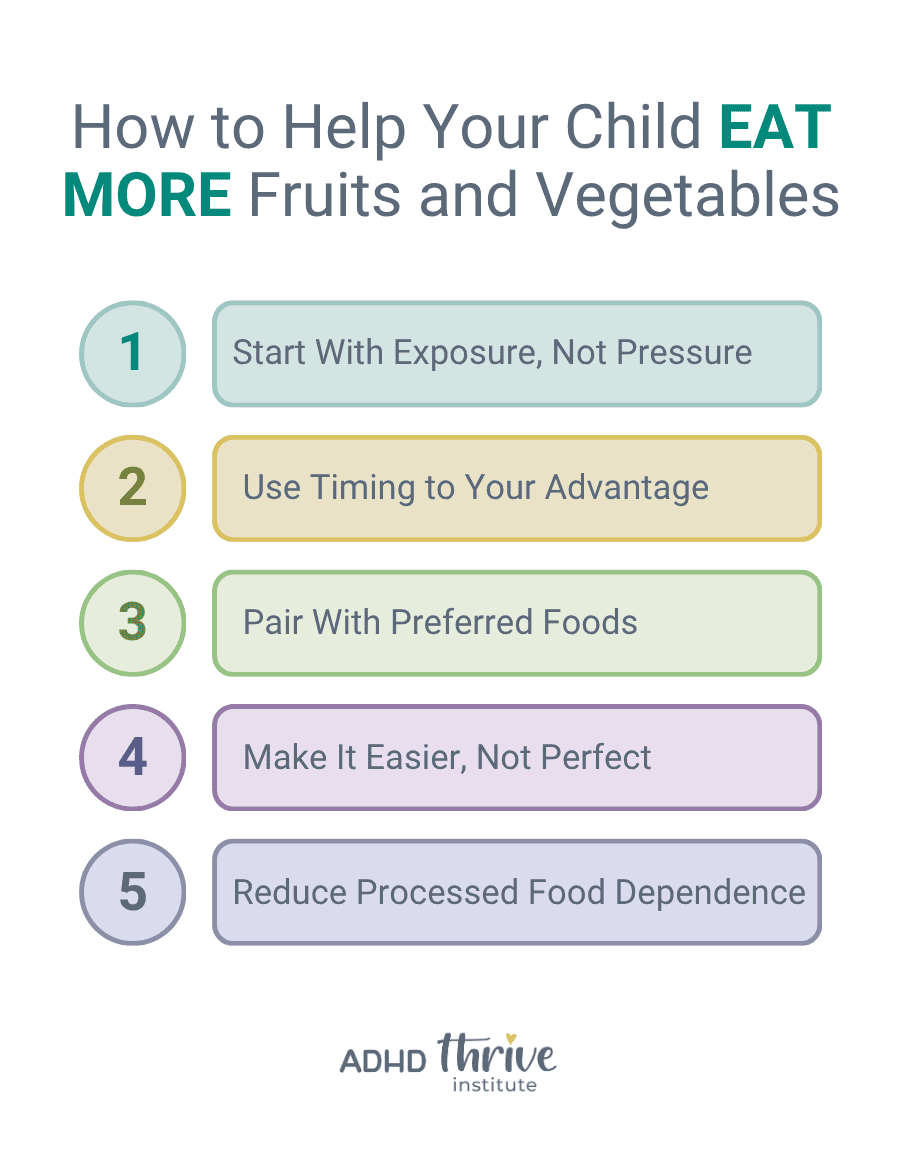
- Start With Exposure, Not Pressure
One of the most important shifts you can make is moving away from pressure and toward exposure. Kids often need to see a food 10–15+ times before they’re willing to try it (and even more before they accept it). That’s normal.
Instead of forcing bites, focus on creating low-pressure opportunities to interact with new foods.
One simple way to do this is something like a “family food challenge” where everyone tries new foods together. It takes the spotlight off your child and makes it feel more like a shared experience instead of a demand.
- Use Timing to Your Advantage
Timing matters more than most people think. If you offer vegetables at the end of a meal (when your child is already full or holding out for something else), you’re setting yourself up for resistance.
Instead, try offering fruits or vegetables before meals, introducing them when your child is actually hungry.
You’ll often see a very different response when appetite is on your side.
- Pair With Preferred Foods
You don’t have to serve vegetables on their own and hope for the best. Pairing them with foods your child already enjoys can make them feel more approachable and less intimidating.
This could look like adding a side of veggies next to a favorite meal or incorporating them into familiar dishes. The goal is to reduce resistance, not create a perfect plate.
- Make It Easier, Not Perfect
Don’t shy away from easier ways to eat fruits and veggies! Frozen vegetables are just as nutritious and often easier than fresh ones. Pre-cut options save time and increase consistency. Smoothies can also be helpful. Many kids who don’t like veggies are okay with a handful of spinach in their fruit smoothie. (They likely won’t even be able to taste it!)
- Reduce Processed Food Dependence
As already mentioned, highly processed foods are designed to be more rewarding to the brain, which can make fruits and vegetables feel less appealing in comparison. Instead of removing everything all at once, start by gradually reducing processed snacks and creating more opportunities for whole foods. This will slowly shift the balance so healthier options become more accepted over time.
Free ADHD Training: What’s Really Driving Symptoms
As you’re thinking about your child’s diet, it’s important to remember this: Nutrition is important, but it’s just one piece of the puzzle.
For many kids with ADHD, there are multiple factors affecting how their brain and body function. Things like gut health, nutrient deficiencies, blood sugar balance, and other biological stressors all play a role in how symptoms show up day to day.
That’s exactly what I walk through in my free ADHD training.
Inside, you’ll learn:
- the most common biological stressors we see in kids with ADHD
- how these show up as intense ADHD symptoms
- why some strategies seem to work for a while…and then stop
- where to start so you’re not trying everything at once
You can save your spot in the free ADHD training here.
FAQs About ADHD Nutrition
How many fruits and vegetables should kids eat each day?
While recommendations vary by age, most children should be eating multiple servings of fruits and vegetables daily. The exact amount depends on age and appetite, but the bigger focus is consistency and making these foods a regular part of your child’s diet.
What if my child refuses to eat vegetables?
This is very common, especially in kids with ADHD. Instead of forcing or pressuring, focus on repeated exposure without pressure. It can take many exposures before a child is willing to try a food, and even longer before they accept it.
Can diet really affect ADHD symptoms?
Diet doesn’t cause ADHD, but it can influence how symptoms show up. Nutrient intake, blood sugar balance, and overall diet quality can all impact focus, mood, and behavior, making symptoms feel more or less intense.
Are smoothies a good way to get fruits and vegetables in?
Smoothies can be a helpful tool, especially for increasing intake, but they shouldn’t be the only way your child consumes fruits and vegetables. Exposure to whole foods is still important for building acceptance over time.
Is picky eating normal for kids with ADHD?
Yes, picky eating is very common in kids with ADHD, often due to sensory sensitivities and preference for predictable foods. But just because something is common doesn’t mean you have to accept it! The goal isn’t to eliminate picky eating overnight, but to gradually expand what your child is comfortable eating.
Resource Mentioned:
Hamner HC, Dooyema CA, Blanck HM, et al. Fruit, Vegetable, and Sugar-Sweetened Beverage Intake Among Young Children, by State — United States, 2021. MMWR Morb Mortal Wkly Rep 2023;72:165–170. DOI: http://dx.doi.org/10.15585/mmwr.mm7207a1.