
I still remember how frustrated I used to feel parenting my son with ADHD. Like most parents, I did what I thought I was supposed to do. I gave warnings, took away privileges, handed out consequences, and repeated myself over and over again. I tried reward charts, being stricter, and being more patient.
Even still, somehow, we kept finding ourselves in the exact same place with the same arguments, power struggles, emotional outbursts, and behaviors.
It was exhausting. (I wrote a post all about parental burnout last week. If you missed it, check it out here.)
At the time, I thought I just needed to become a better parent. I thought if I could find the right strategy, everything would finally click.
But over time, I realized I was using parenting strategies that weren't designed for a child with ADHD.
Many traditional parenting approaches assume that all children can learn to control their impulses, regulate their emotions, transition between activities, and learn from consequences. But children with ADHD often face challenges their peers don’t in these areas.
As a result, parents can find themselves stuck in a frustrating cycle where the harder they try to control behaviors, the worse those behaviors seem to become.
The good news is that there is another way.
Over the years, both through my own family's journey and through working with more than 1,600 families of children with ADHD, I've learned that parenting a child with ADHD often requires a different approach—one that takes into account how the ADHD brain and nervous system actually work.
In this article, we'll cover:
- why traditional parenting strategies often backfire with children who have ADHD
- common ADHD parenting mistakes many well-meaning parents make
- the mindset shift that can completely change how you view your child's behavior
- what ADHD-specific parenting looks like in practice
- practical ADHD parenting strategies you can start using today
- how to create a calmer, more connected home environment
Why Parenting a Child With ADHD Can Feel So Frustrating
One of the biggest challenges parents face is that most parenting advice wasn't created with ADHD in mind. Strategies that may work well for neurotypical children often don't work the same way for children who struggle with impulsivity, emotional regulation, executive functioning, and a highly sensitive nervous system.
As a result, many parents find themselves working harder and harder while seeing fewer results, leaving them feeling exhausted, confused, and discouraged. The reality is that the problem often isn't the parent—it's that the parenting tools being used aren't designed for ADHD.
3 Reasons Why Traditional Parenting Strategies Often Don't Work for ADHD Kids

Traditional parenting strategies are built on the assumption that children can consistently control their behavior, but for many children with ADHD, it's not that simple.
That's why parents often find themselves saying things like:
“He knows better.”
“We've talked about this a hundred times.”
“She knows the rules, so why does this keep happening?”
To understand why traditional parenting approaches often fall short, we first need to understand what's actually driving many ADHD behaviors.
1. ADHD Is Not a Motivation Problem
One of the most important concepts I've learned comes from Dr. Ross Greene*, who famously says, “Kids do well if they can.”
In other words, most children want to succeed. They want to please their parents. They want to do well. They want positive relationships.
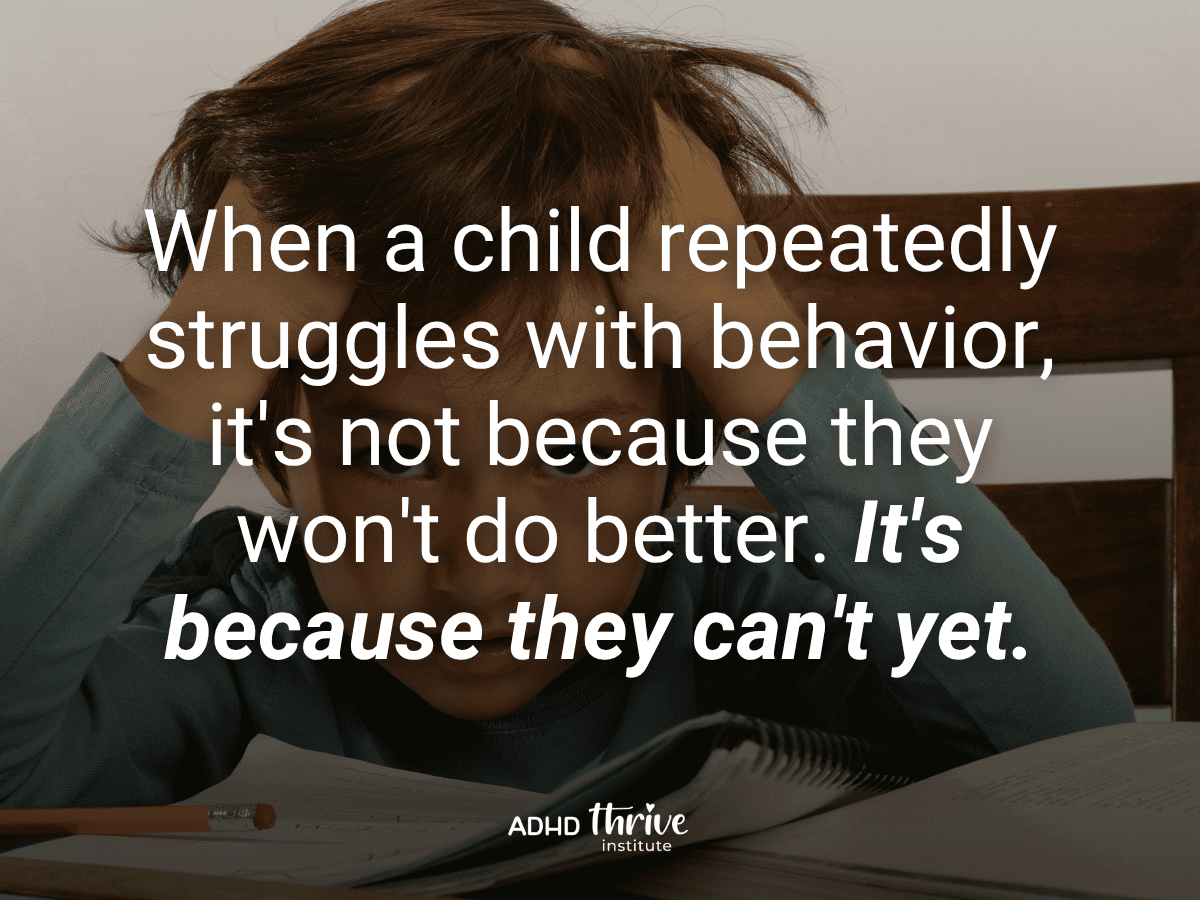
When a child repeatedly struggles with behavior, it's not because they won't do better. It's because they can't yet.
Many ADHD behaviors are linked to challenges with impulse control, emotional regulation, executive functioning, flexibility, and attention. These are skills that develop over time and often develop differently in children with ADHD.
When we view behavior through this lens, it shifts us away from asking, “How do I make my child behave?” And toward asking, “What skills does my child need help developing?”
2. Punishment Doesn't Teach Missing Skills
This doesn't mean children shouldn't have boundaries or accountability. They absolutely should. But punishment alone rarely teaches the skills that ADHD children are missing.
A consequence may stop a behavior temporarily because the child wants to avoid getting in trouble.
What it doesn't necessarily teach is:
- emotional regulation
- impulse control
- flexibility
- frustration tolerance
- executive functioning skills
For example, if a child melts down when plans change unexpectedly, a consequence might discourage the outburst in the short term. But it doesn't teach the child how to manage disappointment, regulate their emotions, or adapt to change. That's why many parents find themselves stuck in the same cycle:

The real question isn't simply, “How do I stop this behavior?” It's, “What skill does my child need in order to handle this situation differently next time?”
3. Many ADHD Behaviors Happen When Kids Are Dysregulated
This is where ADHD parenting often looks very different from traditional parenting advice.
Many behaviors that parents find most challenging happen when a child's nervous system is dysregulated.
When children become overwhelmed, their brains can shift into survival mode.
This may look like:
- fight — arguing, yelling, aggression, defiance
- flight — avoidance, running away, refusing, escaping the situation
- freeze — shutting down, withdrawing, becoming stuck or unable to respond
When a child is in one of these states, they are often not accessing the parts of the brain responsible for logical thinking, problem-solving, learning, and self-control.
In those moments, behavior is often less about choice and more about what their nervous system is communicating. A dysregulated child often needs support getting back to a regulated state before they're capable of learning from the situation.
The ADHD Parenting Mindset Shift That Changes Everything
One of the most powerful parenting mantras I've ever learned is this: “My child is not giving me a hard time. My child is having a hard time.”
(This quote is shared often by many parenting experts, but I believe one of the first ones to say it was L.R. Knost.)
Again, this doesn't mean every behavior is acceptable or that there shouldn't be boundaries. And it certainly doesn't mean children shouldn't be held accountable.
What it means is that behavior is communication.
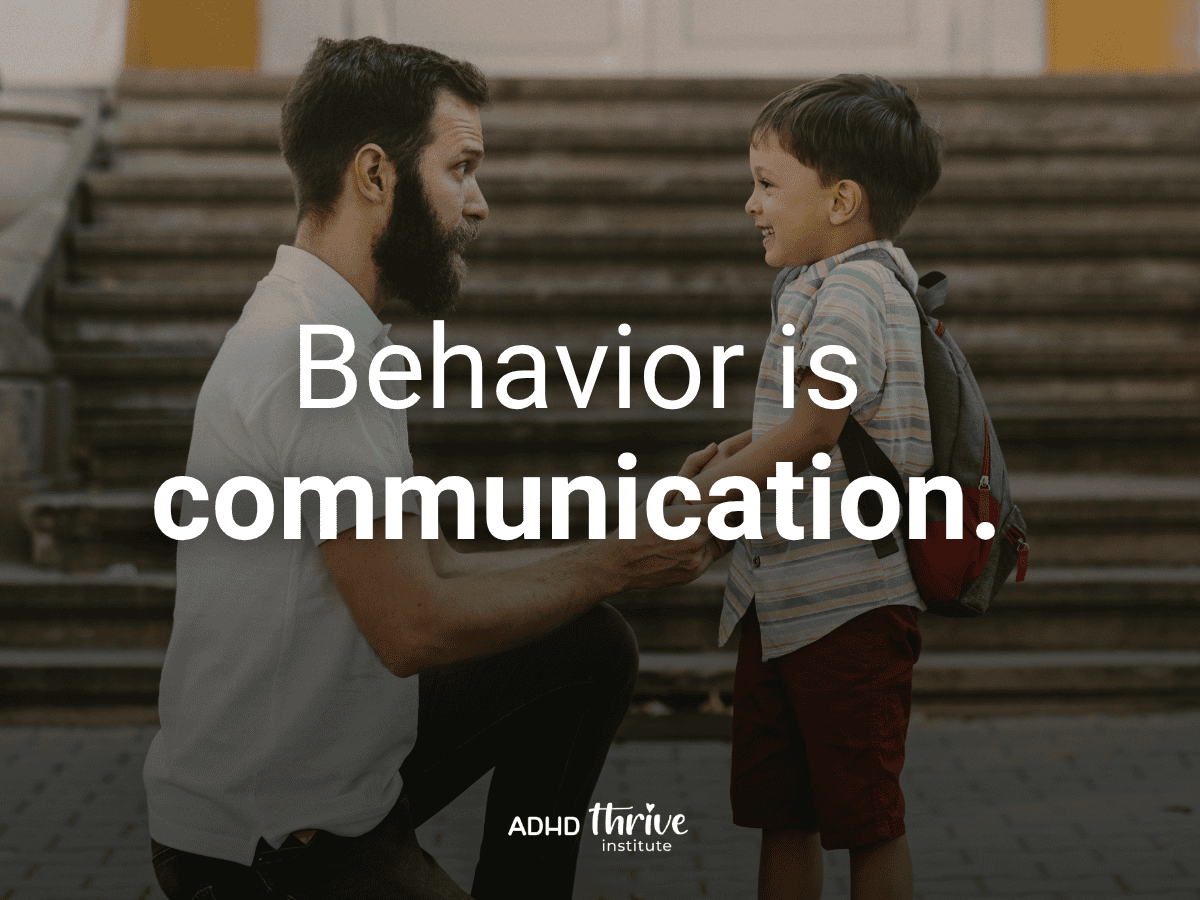
When a child is melting down, arguing, refusing, or acting out, there is usually something happening beneath the surface.
Maybe they're overwhelmed or dysregulated. Maybe they're struggling with a skill they haven't developed yet. Maybe they're feeling anxious, frustrated, disconnected, or overstimulated.
When we view behavior only through the lens of compliance, our focus becomes correcting the behavior as quickly as possible. But when we view behavior as communication, our focus shifts to understanding what's driving it.
What ADHD-Specific Parenting Looks Like
Now that we’ve covered why traditional parenting strategies don’t always work for ADHD kids, let’s talk about what ADHD-specific parenting looks like.
- ADHD-Specific Parenting Looks Beneath the Behavior
Instead of asking, “How do I stop this behavior?” ADHD-specific parenting asks, “What's driving this behavior?” This shift empowers parents to look below the surface of their child's actions and begin identifying what may be contributing to their struggles.
After all, behavior doesn't happen in a vacuum. Nutrition, family stress, parenting dynamics, environmental factors, certain school settings, sleep challenges, and underlying biological stressors can all impact a child's ability to regulate their emotions, attention, and behavior. So can a dysregulated nervous system.
When we focus only on stopping behaviors, we often miss valuable clues about what our children actually need. ADHD-specific parenting looks beneath the behavior to better understand what may be driving it.
- ADHD-Specific Parenting Connects Before It Corrects
One of the most powerful concepts in ADHD-specific parenting is the idea of connection before correction. When children feel emotionally safe, understood, and supported, they are far more receptive to learning, problem-solving, and accepting guidance.
Unfortunately, many parents find themselves trying to correct behavior while their child is still emotionally overwhelmed. A child whose nervous system is in fight, flight, or freeze mode isn't in the best state for learning.
ADHD-specific parenting recognizes that children often need connection before they can access correction.
This might look like helping your child calm their body before discussing what happened. It might mean validating their feelings before addressing their behavior. Or it may simply mean sitting beside them and helping them feel safe enough to regulate.
- ADHD-Specific Parenting Catches A Child Doing Things Right
Many children with ADHD receive a tremendous amount of correction throughout the day. They're reminded to stay on task, corrected for impulsive behavior, redirected when they get distracted, and constantly reminded of expectations.
Over time, this can leave children feeling like adults only notice them when they've done something wrong.
That's why it's so important to actively look for opportunities to catch your child doing something right.
Be specific. Instead of saying, “Good job,” try saying, “I noticed you stayed calm when your brother took the toy.” Or, “I saw how hard you worked to finish that even when it was frustrating.”
Specific praise helps children understand exactly what behaviors you're encouraging while also strengthening their confidence, connection, and sense of competence.
- ADHD-Specific Parenting Sets Expectations Before Problems Happen
Many ADHD children struggle with transitions, uncertainty, and shifting expectations. One simple way to reduce conflict is to clearly communicate expectations before challenging situations arise.
For example, before entering a store, explain what behavior is expected. Before a family gathering, review the plan. Before leaving a fun activity, provide reminders about the upcoming transition. This helps reduce surprises and gives your child's brain time to prepare for what's coming next. Predictability often creates a greater sense of safety, which can make regulation easier.
- ADHD-Specific Parenting Focuses on Teaching, Not Controlling
Traditional parenting often focuses heavily on compliance. ADHD-specific parenting focuses on skill-building.
The goal isn't simply to get your child to obey in the moment, but to help them develop the skills they'll need for long-term success.
Skills like:
- emotional regulation
- frustration tolerance
- impulse control
- flexibility
- problem-solving
- self-awareness
This requires a shift in perspective. Instead of viewing challenging moments as opportunities to gain control, ADHD-specific parenting views them as opportunities to teach.
It focuses on expanding your awareness of your child's emotional, physical, and relational needs and how to respond to those needs, rather than simply trying to manage behaviors.

6 Practical ADHD Parenting Strategies You Can Start Today
Understanding ADHD-specific parenting is important, but many parents wonder what they can start doing differently right away. Here are a few simple strategies that can make a big difference over time.
- Create a 10-Minute Connection Ritual
Set aside 10 minutes a day (or a few times a week) to give your child your full attention. Let them choose the activity and focus on connecting rather than correcting.
- Use Visual Routines
Many children with ADHD struggle with working memory and executive functioning. Visual schedules and checklists can help reduce reminders, increase independence, and make daily routines smoother.
- Give Transition Warnings
Transitions are often difficult for ADHD kids. Giving reminders like “10 more minutes” or “one more turn” can help reduce resistance and emotional outbursts.
- Offer Choices
Whenever possible, give your child appropriate choices within the boundaries you've already set. This can increase cooperation and reduce power struggles.
- Choose Your Battles
Not every issue needs to become a conflict. Learning to let go of the small stuff can help preserve your energy and reduce tension at home.
- Celebrate Small Wins
Progress is often made through small steps. Notice and acknowledge your child's efforts, growth, and positive choices along the way. Those small wins add up over time.
You Don't Have to Figure This Out Alone
Parenting a child with ADHD often requires a different set of tools than many of us were taught growing up. Unfortunately, most parents are handed generic parenting advice and then left wondering why it doesn't seem to work for their child.
If you've been feeling frustrated, stuck in power struggles, or unsure how to respond to your child's behaviors, you don't have to figure it out by yourself.
Introducing The ADHD Thrive Jumpstart 4 Parenting Program
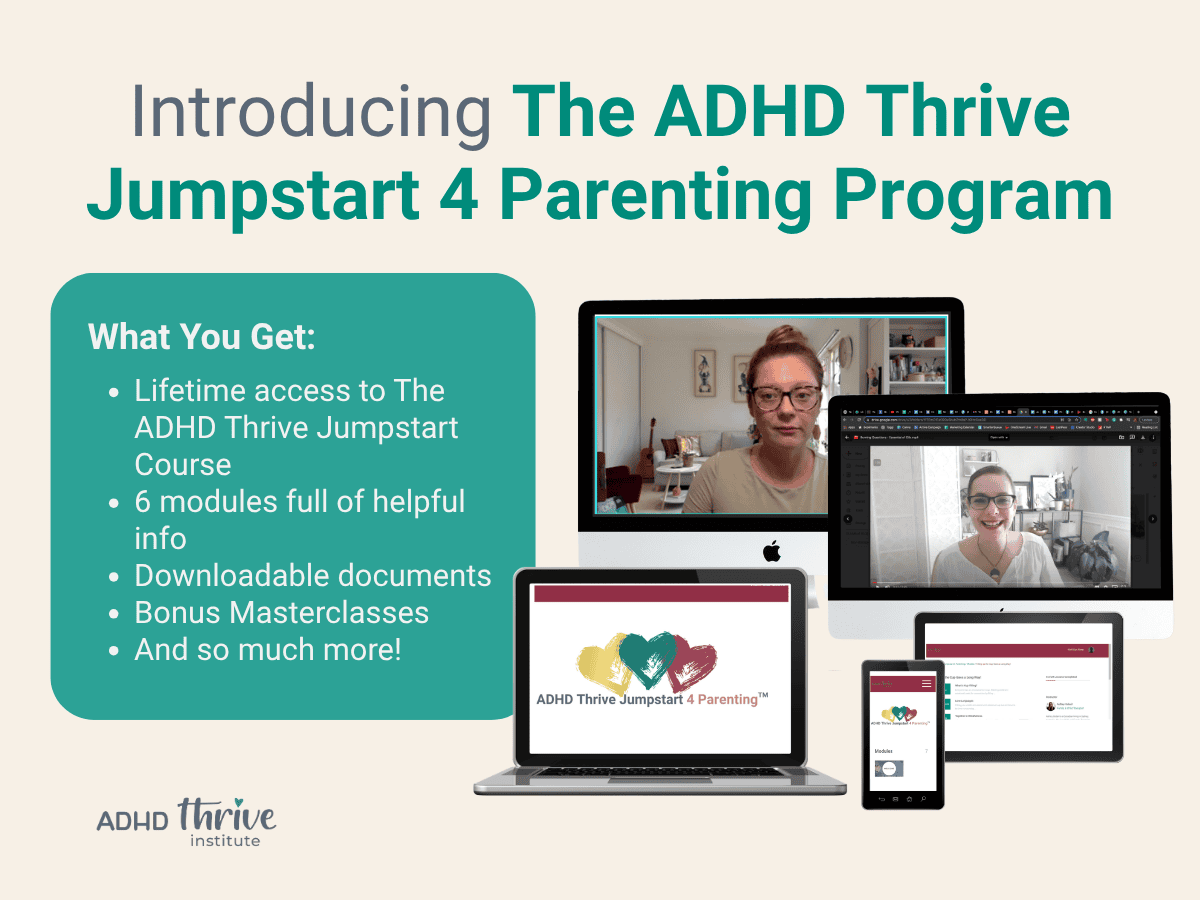
Most parenting programs are designed for neurotypical children. The ADHD Thrive Jumpstart 4 Parenting program was created specifically for families raising children with ADHD.
Inside, you'll learn practical ADHD-specific parenting strategies that help you:
- respond more effectively to ADHD behaviors
- use connection before correction
- create routines and rituals that support success
- help your child build emotional regulation skills
- reduce power struggles and create a calmer home environment
If you're ready to start using strategies designed by Ashley Gobeil, a licensed Child and Family Therapist, and created specifically for ADHD families, the ADHD Thrive Jumpstart 4 Parenting program can help you build the skills, confidence, and understanding needed to support your child with greater success.
Click here to learn more about the ADHD Thrive Jumpstart 4 Parenting program.
In addition to this program, Ashley is also a regular guest on our Soaring Child podcast. Listen to all of her episodes here.
The Bigger Picture: Behavior Is Often a Symptom
One of the most important things I've learned—both as a parent and through working with more than 1,600 families—is that behavior is often the visible symptom of something deeper.
Parents typically come to us concerned about behaviors such as:
- meltdowns
- defiance
- emotional outbursts
- impulsivity
- difficulty following directions
And while those behaviors absolutely need to be addressed, it's important to remember that they don't occur in isolation.
As we’ve mentioned throughout this article, children with ADHD may also be struggling with nervous system dysregulation, poor sleep, gut health challenges, inflammation, nutrient deficiencies, or other biological stressors that can amplify ADHD symptoms and make self-regulation more difficult.
To be clear, these factors don't necessarily cause behaviors like defiance or emotional outbursts, but they can influence the severity of symptoms that contribute to those behaviors.
This is one of the reasons traditional parenting strategies often fall short. They focus almost exclusively on changing behavior while overlooking the skills, challenges, and stressors that may be driving that behavior in the first place.
When we begin to understand what's happening beneath the surface, everything changes. We stop asking, “How do I make my child behave?” and start asking, “What does my child need from me right now?” That shift often leads to less conflict, more connection, and a calmer home environment.
If you're looking for help implementing these ADHD-specific parenting strategies, I encourage you to check out the ADHD Thrive Jumpstart 4 Parenting program.
Because at the end of the day, your child is not giving you a hard time. Your child is having a hard time, and when we understand that behavior is often a symptom (not the whole story), we can begin parenting in a way that helps both our children and our families thrive.
FAQs About Parenting a Child With ADHD
How do you discipline a child with ADHD?
Effective discipline for children with ADHD focuses on teaching skills rather than simply punishing behavior. Clear expectations, consistency, connection, and appropriate consequences can be helpful, but children also need support developing skills like emotional regulation, impulse control, and problem-solving.
Why doesn't punishment work for ADHD?
Punishment may temporarily stop a behavior, but it doesn't teach the underlying skills many children with ADHD struggle with. If a child lacks emotional regulation, flexibility, or impulse control, consequences alone often don't create lasting change.
What is ADHD-specific parenting?
ADHD-specific parenting recognizes the unique challenges associated with ADHD, including executive functioning difficulties, emotional dysregulation, and nervous system sensitivity. It focuses on understanding what's driving behavior, strengthening connection, teaching skills, and creating supportive environments that help children succeed.
How can I reduce power struggles with my ADHD child?
Reducing power struggles often starts with setting clear expectations, offering choices when appropriate, preparing for transitions, focusing on connection, and choosing your battles wisely. Understanding the reason behind a behavior can also help parents respond more effectively.
What parenting style works best for ADHD?
Research suggests that responsive, connected parenting approaches tend to be more effective than highly authoritarian or permissive styles for children with ADHD. Children benefit from clear boundaries, emotional support, consistent expectations, and parents who focus on teaching skills rather than controlling behavior.
For Additional Study:
*To learn more about Dr. Ross Greene’s popular parenting strategies and the Collaborative and Proactive Solutions model that he teaches, tune in to this podcast episode with Kim Hopkins.
ADHD in Children, https://www.cdc.gov/adhd/about/index.html Accessed 06/22/2026.
Bhide S, Sciberras E, Anderson V, Hazell P, Nicholson JM. Association Between Parenting Style and Social Outcomes in Children with and Without Attention-Deficit/Hyperactivity Disorder: An 18-Month Longitudinal Study. J Dev Behav Pediatr. 2017 Jul/Aug;38(6):369-377. doi: 10.1097/DBP.0000000000000453. PMID: 28661954.

Dekkers TJ, Hornstra R, van der Oord S, Luman M, Hoekstra PJ, Groenman AP, van den Hoofdakker BJ. Meta-analysis: Which Components of Parent Training Work for Children With Attention-Deficit/Hyperactivity Disorder? J Am Acad Child Adolesc Psychiatry. 2022 Apr;61(4):478-494. doi: 10.1016/j.jaac.2021.06.015. Epub 2021 Jul 2. PMID: 34224837.

Doffer DPA, Dekkers TJ, Hornstra R, van der Oord S, Luman M, Leijten P, Hoekstra PJ, van den Hoofdakker BJ, Groenman AP. Sustained improvements by behavioural parent training for children with attention-deficit/hyperactivity disorder: A meta-analytic review of longer-term child and parental outcomes. JCPP Adv. 2023 Sep 4;3(3):e12196. doi: 10.1002/jcv2.12196. PMID: 37720584; PMCID: PMC10501699.

Kurman J, Rothschild-Yakar L, Angel R, Katz M. How Good Am I? Implicit and Explicit Self-Esteem as a Function of Perceived Parenting Styles Among Children With ADHD. J Atten Disord. 2018 Nov;22(13):1207-1217. doi: 10.1177/1087054715569599. Epub 2015 Feb 11. PMID: 25672670.

Marquet-Doléac J, Biotteau M, Chaix Y. Behavioral Parent Training for School-Aged Children With ADHD: A Systematic Review of Randomized Control Trials. J Atten Disord. 2024 Feb;28(3):377-393. doi: 10.1177/10870547231211595. Epub 2023 Dec 11. PMID: 38083879.

Porges SW. The polyvagal theory: new insights into adaptive reactions of the autonomic nervous system. Cleve Clin J Med. 2009;76 Suppl 2(Suppl 2):S86-S90. doi:10.3949/ccjm.76.s2.17

Zwi M, Jones H, Thorgaard C, York A, Dennis JA. Parent training interventions for Attention Deficit Hyperactivity Disorder (ADHD) in children aged 5 to 18 years. Cochrane Database Syst Rev. 2011 Dec 7;2011(12):CD003018. doi: 10.1002/14651858.CD003018.pub3. PMID: 22161373; PMCID: PMC6544776.