
Have you ever noticed that your child’s ADHD symptoms seem to ramp up during back-to-school season?
It makes sense if you think about it. Back-to-school season often brings with it: less sleep, rushed mornings, homework, new teacher expectations, changes in routine, etc. Plus, your child is expected to sit still, pay attention, remember directions, manage big emotions, and hold it together for hours at a time.
That is a lot for any child, but it’s especially difficult for kids with ADHD. As a result, you may find yourself wondering, “Is there anything else I can do to support my child?”
That is where supplements often come into the conversation.
Parents ask me all the time, “What are the best supplements for ADHD?” and “What are the best supplements for back to school?” I completely understand why parents ask these questions. When your child is struggling, you want to find something that may help.
But let me say this right from the start: there is no one-size-fits-all supplement plan, and there is no miracle bottle that will “fix” ADHD.

You cannot supplement your way out of a poor diet, poor sleep, chronic stress, or a body that is dealing with underlying stressors.
That being said, there are a few supplements I have seen many ADHD children do really well with when they are used thoughtfully as part of a bigger plan.
In this article, I’ll walk you through five of my favorite supplements for supporting kids with ADHD during the back-to-school season: magnesium, vitamin D, omega-3 fatty acids, a probiotic and saffron combination, and vitamin C.
You’ll learn:
- Why these five supplements may be especially helpful during the school year
- How they may support focus, emotional regulation, sleep, brain health, gut health, and immune function
- Why you can’t ignore diet
- Why not all supplements are created equal and what to look for when choosing a high-quality product
- My favorite supplement options and why I recommend them
By the end of this article, you’ll have a better understanding of which supplements may be worth discussing with your child’s practitioner so you can head into the school year feeling more confident about how to support your child’s brain and body.
Before You Buy Any ADHD Supplement, Read This First
Before we dive into my favorite supplements for kids with ADHD, there’s something important I want you to know: supplements are exactly that—supplements.
They are meant to supplement a healthy lifestyle, not replace one.

I always tell the families I work with that food is our first medicine. You simply can’t supplement your way out of a poor diet. That’s why I always recommend starting with the foundations first: a nutrient-dense diet, quality sleep, regular movement, and reducing inflammatory foods.
It’s also important to remember that there is no one-size-fits-all approach to supplementation. A supplement that works wonders for one child may do very little for another, and in some cases, the wrong supplement, form, dose, or timing can actually make symptoms worse.
I always recommend working with a qualified healthcare practitioner and using functional lab testing to identify your child's unique needs before starting supplements. It's also important to review your child's medications, diagnoses, allergies, and health history to make sure any supplement is appropriate and won't interfere with other treatments. If you do decide to begin supplementation, introduce one new supplement at a time so you can clearly see how your child's body responds.
If you'd like to learn more about how I use functional lab testing to personalize supplement recommendations, watch this video on the functional lab tests I often recommend for children with ADHD before getting started.
The 5 Best ADHD Supplements for Back-To-School Season
- Magnesium
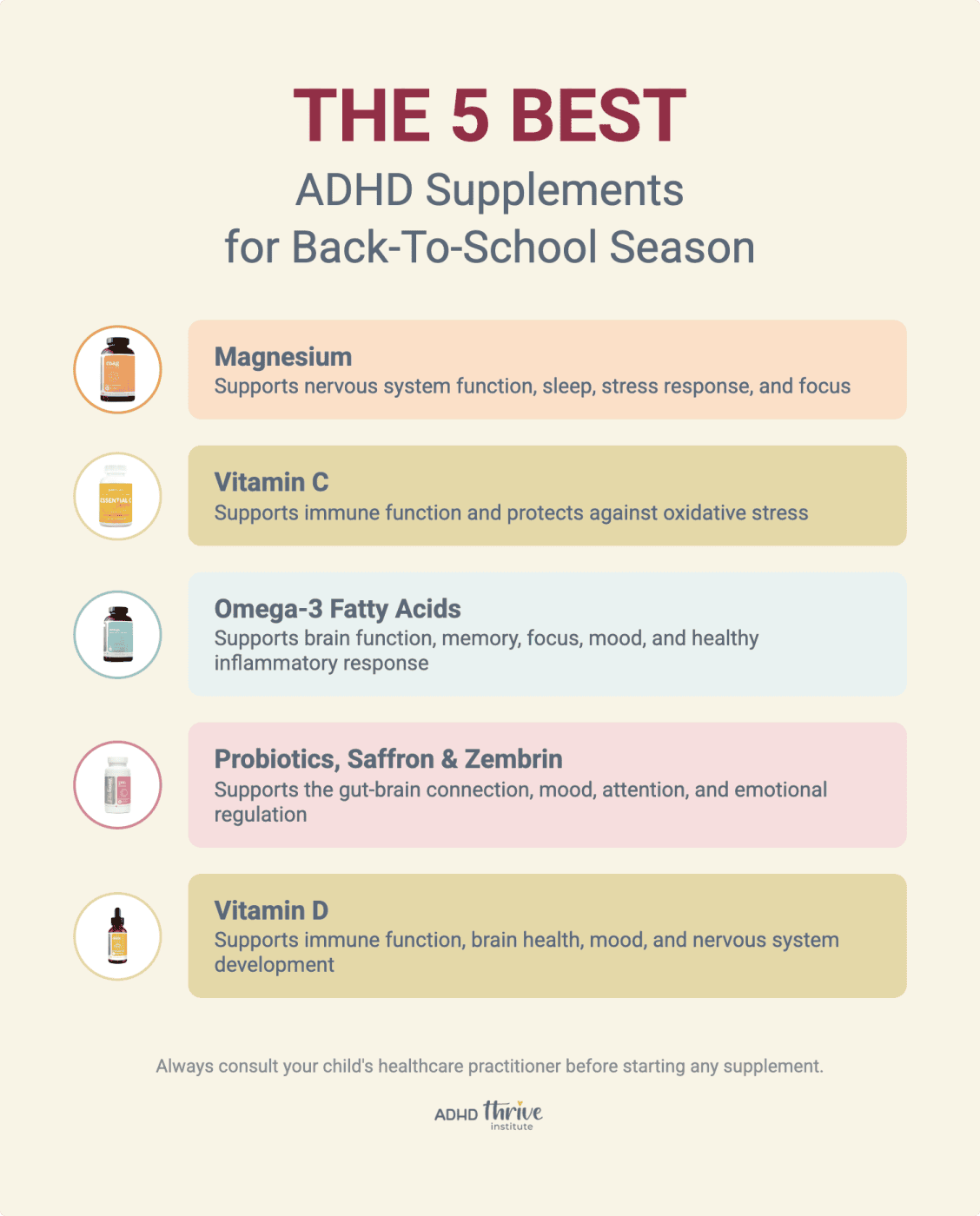
If you've spent any time researching natural supplements for ADHD, you've probably come across magnesium (and for good reason). Magnesium is involved in more than 300 biochemical processes throughout the body and plays an important role in supporting the nervous system, sleep, stress response, mood, and focus.
Many children with ADHD struggle with sleep difficulties, emotional regulation, and feelings of stress or anxiety. Magnesium helps support healthy nervous system function, which is why it's one of my favorite supplements to consider as children transition back into the demands of the school year.
Where to Find Magnesium Naturally
Before reaching for a supplement, try incorporating more magnesium-rich foods into your child's diet, including:
- Spinach and kale
- Pumpkin seeds
- Almonds
- Sunflower seeds
- Avocados
- Bananas
- Black beans and lentils
- Salmon
My Favorite Magnesium Supplement
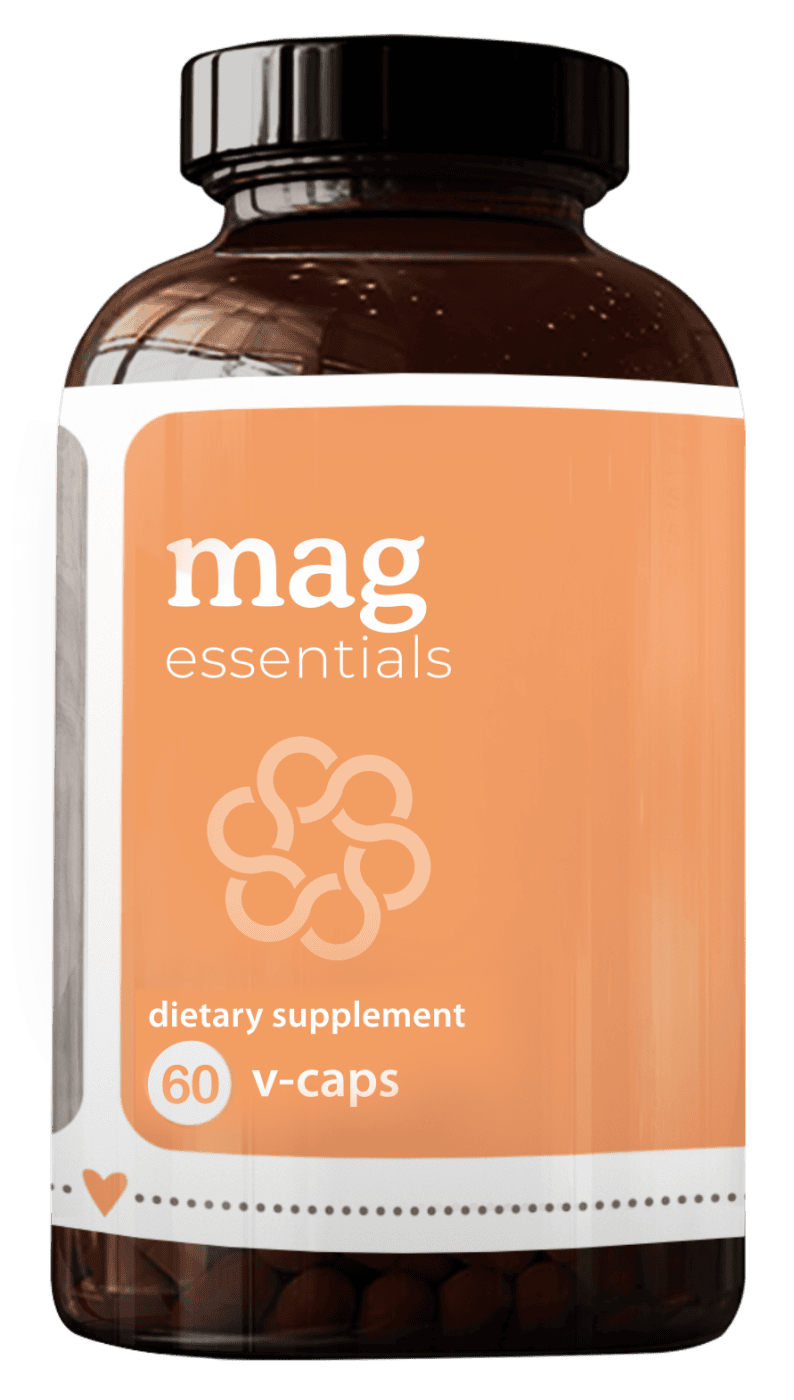
Not all magnesium supplements are created equal. Different forms of magnesium work differently in the body. For instance, magnesium citrate can have a mild laxative effect, so it’s helpful for occasional constipation. Magnesium malate, on the other hand, may support mood, energy, and focus. As you can see, different forms of magnesium serve different purposes, which is why I created Mag Essentials, specifically for ADHD kids. It combines three highly absorbable forms of magnesium:
- Magnesium Glycinate for absorption, calm, and brain nourishment
- Sucrosomial™ Magnesium for advanced absorption and nervous system balance
- Magnesium Malate for mood, energy, and cognitive function
Listen to my podcast episode on Magnesium for ADHD here.
- Omega-3 Fatty Acids
Omega-3 fatty acids are essential fats, which means our bodies cannot make them on their own. They must come from food or supplementation. Unfortunately, most children don't eat enough omega-3-rich foods, making this one of the most common nutrient gaps I see.
Omega-3s—especially EPA and DHA—may support brain function, memory, focus, mood, and organizational skills. They also help maintain a healthy inflammatory response, which is another reason they're one of my favorite supplements for children with ADHD.
Remember, though, omega supplements aren't a magic fix. They work best when combined with a whole-food diet and other strategies that reduce inflammation.
Where to Find Omega-3 Naturally
Foods naturally rich in omega-3s include:
- Wild-caught salmon
- Trout
- Sardines
- Mackerel
- Tuna
- Chia seeds
- Flaxseeds
- Walnuts
My Favorite Omega Supplement
I recommend Omega Essentials because it provides high-quality EPA and DHA and is available in both liquid and capsule forms, making it easy for children of all ages to take.
Shop Omega Essentials Soft Gels here.
Shop Omega Essentials Liquid here.
Listen to my podcast episode on Omegas for ADHD here.
Download the FREE Omega Cheat Sheet here.

- Probiotics, Saffron, & Zembrin
One of the most exciting areas of ADHD research right now is the gut-brain connection. The gut and brain are constantly communicating, which means gut health may influence much more than digestion. It can also play a role in mood, stress response, focus, and executive function.
That’s why I love the combination of probiotics, saffron, and Zembrin.
Probiotics help support a healthy gut microbiome, but not all probiotics are created equal. Some strains do not survive the digestive process well, which means they may never reach the gut where they are needed. Spore-forming probiotics are designed to survive digestion and help support a more balanced microbiome.
Saffron is a spice that has been studied for its possible effects on attention, mood, emotional regulation, and restlessness. The research is still developing, but the results so far are promising.
Zembrin is a standardized extract made from Sceletium tortuosum, a succulent plant native to South Africa. It has been clinically studied for cognitive flexibility, executive function, stress response, and mood. In simple terms, that means it may help support the skills kids with ADHD often struggle with most, such as shifting between tasks, planning, staying organized, managing impulses, and calming down when they feel overwhelmed.
Where to Find Them Naturally
You can support your child’s gut naturally with fermented foods such as:
- Sauerkraut
- Kimchi
- Coconut yogurt with live cultures
- Dairy-free kefir
- Other fermented vegetables
Saffron can be used as a spice in rice dishes, soups, stews, tea, or dairy-free milk.
Zembrin is different. It is a standardized extract, so it is not typically found in food. It is available in certain supplements, powders, and functional foods.
My Favorite Probiotic, Saffron, and Zembrin Supplement
My favorite is Pro Essentials because it combines three powerful ingredients in one formula:
- A spore-forming probiotic to support the gut microbiome
- Saffron extract to support mood, attention, and emotional balance
- Zembrin to support cognitive flexibility, executive function, calm focus, and stress regulation
This combination makes Pro Essentials one of my favorite supplements for back-to-school support because it targets several areas that can become more challenging when school begins, including transitions, organization, focus, stress, and emotional regulation.
As always, this is not a quick fix or a replacement for a healthy diet and lifestyle. Additionally, as with all supplements, parents should speak with a qualified healthcare practitioner before using it.
Listen to my podcast episode on Saffron here.
Download the FREE Saffron Cheat Sheet here.
Listen to my podcast episode on Zembrin for ADHD here.
Download the FREE Zembrin Cheat Sheet here.

- Vitamin D
Often called the “sunshine vitamin,” vitamin D supports much more than bone health. It also plays an important role in immune function, brain health, mood, and nervous system development.
Because many children spend more time indoors during the school year and because vitamin D deficiency is common among kids with ADHD, I often recommend supplementing with vitamin D.
Rather than repeating everything here, I've written an entire article dedicated to vitamin D and ADHD that you can read after this one. Read it here.
Where to Find Vitamin D Naturally
Vitamin D can be found through:
- Safe sun exposure
- Salmon
- Tuna
- Sardines
- Egg yolks
- Mushrooms exposed to sunlight
My Favorite Vitamin D Supplement
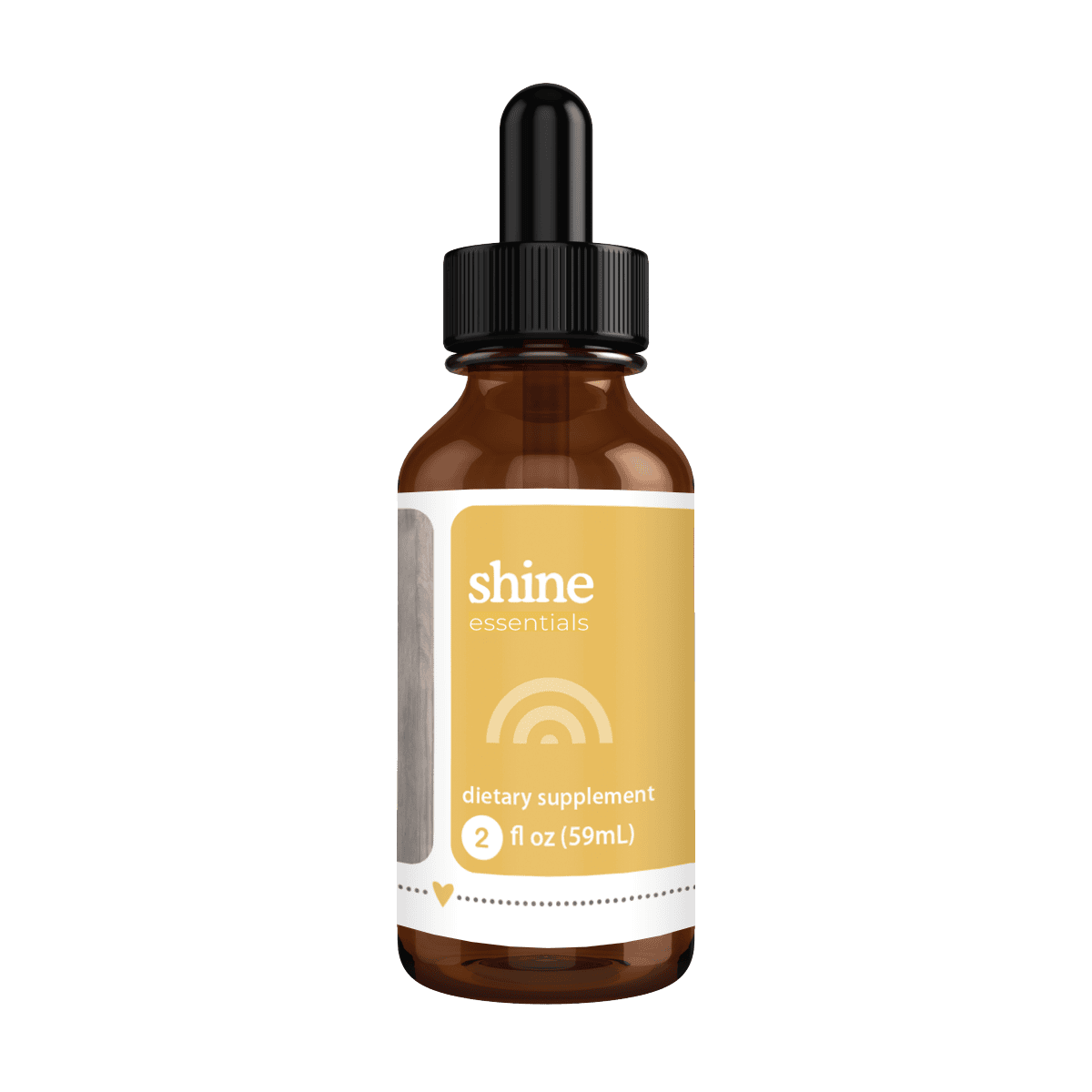
When supplementation is appropriate, I recommend Shine Essentials because it combines vitamin D3 with vitamin K2, which work together to support healthy vitamin D metabolism.
Read my complete guide to Vitamin D for ADHD here.
Listen to my podcast episode on Vitamin D here.
Download the FREE Vitamin D Cheat Sheet here.
- Vitamin C
Vitamin C is probably best known for supporting the immune system, which makes it especially helpful as children head back to school and are exposed to more germs. But vitamin C also acts as a powerful antioxidant, helping protect the body from oxidative stress and supporting overall health.
Our bodies cannot make vitamin C on their own, so it's important to get enough through food. If your child has a limited diet or needs additional support, supplementation may be worth discussing with your healthcare practitioner.
One important note: vitamin C should not be taken at the same time as certain prescription medications, so always ask your practitioner about proper timing.
Where to Find Vitamin C Naturally
Vitamin C-rich foods include:
- Bell peppers
- Kiwi
- Strawberries
- Citrus fruits
- Broccoli
- Kale
- Mango
- Guava
- Tomatoes
My Favorite Vitamin C Supplement
One of my favorite vitamin C supplements is Paleovalley's Essential C Complex because it's made from whole-food, non-GMO plant sources and has excellent quality standards.
Shop Paleovalley's Essential C Complex here.
Read my article about Vitamin C for Kids with ADHD here.

Ready to Support Your ADHD Child This School Year?
The five supplements we've covered in this article—magnesium, omega-3 fatty acids, probiotics with saffron and Zembrin, vitamin D, and vitamin C—are some of my favorite tools for supporting children with ADHD during the school year. Each one offers different benefits, from supporting brain health, focus, and executive function to promoting emotional regulation, sleep, gut health, immune function, and a healthy stress response.
But remember, the best supplement isn't the most popular one. It's the one your child actually needs.

Every child is unique. Their nutrient needs, genetics, gut health, diet, lifestyle, and overall health history all play a role in determining which supplements may be most beneficial. That's why I always encourage families to take an individualized approach rather than trying every supplement they read about online.
Above all, never forget this: you cannot supplement your way out of a poor diet, and there is no miracle bottle for ADHD. Food is always the foundation. When you combine a nutrient-dense diet, healthy lifestyle habits, reduced inflammation, and the right supplements chosen for your child's unique needs, you create the best opportunity for your child to thrive, both in the classroom and beyond.
If you're looking for high-quality supplements that I personally recommend and use with the families I work with, you can shop my favorite back-to-school supplements at my online store.
Not sure which supplements are right for your child? Before you buy anything, I encourage you to learn about the functional lab testing I often use to help identify nutrient deficiencies and underlying imbalances so you can make informed decisions based on your child's individual needs. Watch my free video on the functional lab tests I often recommend for children with ADHD here.
Here's to a calmer, healthier, and more successful school year for your child!
Frequently Asked Questions About ADHD Supplements for Kids
- What is the best supplement for ADHD in children?
There isn't one supplement that works best for every child with ADHD. The right choice depends on your child's diet, nutrient status, gut health, genetics, and overall health. Some of the supplements I recommend most often include magnesium, omega-3 fatty acids, probiotics with saffron and Zembrin, vitamin D, and vitamin C, but they should always be part of a personalized plan.
- Should I give my child multiple ADHD supplements at the same time?
I recommend introducing one supplement at a time whenever possible. This makes it much easier to see how your child responds and identify any side effects or digestive changes. Before adding multiple supplements, talk with a qualified healthcare practitioner and consider functional lab testing to help identify your child's specific needs.
- Can supplements replace ADHD medication?
Supplements are not a replacement for ADHD medication, nor are they a cure for ADHD. Some families choose to use supplements alongside medication, while others use them as part of a natural approach. Every child is different, so it's important to work with your healthcare provider to determine the best plan for your family.
- How long does it take for ADHD supplements to work?
It depends on the supplement and your child's individual needs. Some children notice changes within a few weeks, while others may take several months to experience benefits. Consistency is key, and supplements tend to work best when combined with a nutrient-dense diet, quality sleep, regular movement, and other healthy lifestyle habits.
- Should my child have functional lab testing before taking supplements?
Whenever possible, yes. Functional lab testing can help identify nutrient deficiencies, gut health imbalances, inflammation, and other underlying factors that may be contributing to ADHD symptoms. Rather than guessing which supplements your child needs, testing allows you to create a more personalized and targeted plan. Learn more by watching my free video on the functional lab tests I often recommend for children with ADHD.
For Additional Study:
https://www.ox.ac.uk/news/2012-09-07-omega-3-fatty-acids-could-improve-reading-and-behaviour

https://www.nature.com/articles/npp2017160

https://www.liebertpub.com/doi/pdf/10.1089/cap.2018.0146

https://pubmed.ncbi.nlm.nih.gov/36235697/

https://journals.lww.com/hnpjournal/citation/2020/01000/saffron__crocus_sativus_l____a_phytomedicine_as.8.aspx

https://brieflands.com/articles/ijpbs-108390

Anjum I, Jaffery SS, Fayyaz M, Samoo Z, Anjum S. “The Role of Vitamin D in Brain Health: A Mini Literature Review.” Cureus. 2018 Jul 10;10(7):e2960. doi: 10.7759/cureus.2960. PMID: 30214848; PMCID: PMC6132681.

Greenblatt, James M. “Mental Health in the Sun: The Role of Vitamin D Deficiency in Mental Illness.” psychiatrictimes.com. 2024 Oct 16. https://www.psychiatrictimes.com/view/mental-health-in-the-sun-the-role-of-vitamin-d-deficiency-in-mental-illness  Accessed 2024 Jan 28.

Hemamy M, Pahlavani N, Amanollahi A, Islam SMS, McVicar J, Askari G, Malekahmadi M. “The effect of vitamin D and magnesium supplementation on the mental health status of attention-deficit hyperactive children: a randomized controlled trial.” BMC Pediatr. 2021 Apr 17;21(1):178. doi: 10.1186/s12887-021-02631-1. Erratum in: BMC Pediatr. 2021 May 12;21(1):230. doi: 10.1186/s12887-021-02683-3. PMID: 33865361; PMCID: PMC8052751.

Khoshbakht Y, Bidaki R, Salehi-Abargouei A. “Vitamin D Status and Attention Deficit Hyperactivity Disorder: A Systematic Review and Meta-Analysis of Observational Studies.” Adv Nutr. 2018 Jan 1;9(1):9-20. doi: 10.1093/advances/nmx002. PMID: 29438455; PMCID: PMC6333940.

Sharif MR, Madani M, Tabatabaei F, Tabatabaee Z. “The Relationship between Serum Vitamin D Level and Attention Deficit Hyperactivity Disorder.” Iran J Child Neurol. 2015 Fall;9(4):48-53. PMID: 26664441; PMCID: PMC4670977.

Berry AR, Langley HN, Rogers RR, et al. Effects of Zembrin® (Sceletium tortuosum) Supplementation on Mood, Soreness, and Performance Following Unaccustomed Resistance Exercise: A Pilot Study. Nutraceuticals. 2021;1:2–11. doi: 10.3390/nutraceuticals1010002

Chiu S, Gericke N, Farina-Woodbury M, et al. Proof-of-Concept Randomized Controlled Study of Cognition Effects of the Proprietary Extract Sceletium tortuosum (Zembrin) Targeting Phosphodiesterase- 4 in Cognitively Healthy Subjects: Implications for Alzheimer’s Dementia. Evid Based Complement Alternat Med. 2014;2014:682014. doi:10.1155/2014/682014

Dimpfel W, Gericke N, Suliman S, Dipah GNC. Effect of Zembrin® on Brain Electrical Activity in 60 Older Subjects after 6 Weeks of Daily Intake. A Prospective, Randomized, Double-Blind, Placebo- Controlled, 3-Armed Study in a Parallel Design. World J Neurosci. 2017;7:140-71.

Dimpfel W, Gericke N, Suliman S, Dipah GNC. Psychophysiological Effects of Zembrin® Using Quantitative EEG Source Density in Combination with Eye-Tracking in 60 Healthy Subjects. A Double-Blind, Randomized, Placebo-Controlled, 3-Armed Study with Parallel

Design. Neurosci Med. 2016;7:114-32. doi:10.4236/nm.2016.73013

Dimpfel W, Schombert L, Gericke N. Electropharmacogram of Sceletium tortuosum extract based on spectral local field power in conscious freely moving rats. J Ethnopharmacol. 2016;177:140-147. doi:10.1016/j.jep.2015.11.036

GRAS Dossier: The Independent Conclusion that the Intended Use of Zembrin® Is Generally Recognized as Safe (GRAS). AIBMR Life Sciences. [Data on file]

Harvey AL, Young LC, Viljoen AM, Gericke NP. Pharmacological actions of the South African medicinal and functional food plant Sceletium tortuosum and its principal alkaloids. J Ethnopharmacol. 2011;137(3):1124-1129. doi:10.1016/j.jep.2011.07.035

Hirabayashi M, et al. Clinical effects of South African Tea for Cat. Japan J Small Animal Practice. 2004;23(2):85-87

Hirabayashi M, Ichikawa K, Fukushima R, et al. Clinical application of South African tea on dementia dog. Japanese J Small Animal Pract. 2002; 21:109–113 [in Japanese].

Hirai M, et al. Clinical effects of South African Tea for dementia animal. Japan J Small Animal Practice. 2005;24(1):27-31.

Jurkowski G. ADME-Tox. Study of Compound 8587. Final Report 154851CDR, Cerep, Redmond, WA. Report on file.

Manda VK, Avula B, Ashfaq MK, Abe N, Khan IA, Khan SI. Quantification of mesembrine and mesembrenone in mouse plasma using UHPLC-QToF-MS: Application to a pharmacokinetic study. Biomed Chromatogr. 2017;31(3):10. 1002/bmc.3815. doi:10.1002/bmc.3815

Murbach TS, Hirka G, Szakonyiné IP, Gericke N, Endres JR. A toxicological safety assessment of a standardized extract of Sceletium tortuosum (Zembrin®) in rats. Food Chem Toxicol. 2014;74:190-199.

Murbach TS, Hirka G, Szakonyiné IP, Gericke N, Endres JR. A toxicological safety assessment of a standardized extract of Sceletium tortuosum (Zembrin®) in rats. Food Chem Toxicol. 2014;74:190-199. doi:10.1016/j.fct.2014.09.017

Nell H, Siebert M, Chellan P, Gericke N. A randomized, double-blind, parallel-group, placebo-controlled trial of Extract Sceletium tortuosum (Zembrin) in healthy adults. J Altern Complement Med. 2013;19(11):898-904. doi:10.1089/acm.2012.0185

Oketch HA, Pizzorno J, LaValle J. Determination of the Generally Recognized as Safe (GRAS) Status of Zembrin®, (Sceletium tortuosum Extract) as an Ingredient in Selected Foods, 2011 [Data on file].

Reay J, Wetherell MA, Morton E, Lillis J, Badmaev V. Sceletium tortuosum (Zembrin®) ameliorates experimentally induced anxiety in healthy volunteers [published online ahead of print, 2020 Aug 6]. Hum Psychopharmacol. 2020;e2753. doi:10.1002/hup.2753

Shikanga EA, Hamman JH, Chen W, Combrinck S, Gericke N, Viljoen AM. In vitro permeation of mesembrine alkaloids from Sceletium tortuosum across porcine buccal, sublingual, and intestinal mucosa. Planta Med. 2012;78(3):260-268. doi:10.1055/s-0031-1280367

Terburg D, Syal S, Rosenberger LA, et al. Acute effects of Sceletium tortuosum (Zembrin), a dual 5-HT reuptake and PDE4 inhibitor, in the human amygdala and its connection to the hypothalamus. Neuropsychopharmacology. 2013;38(13):2708-2716. doi:10.1038/ npp.2013.183