

“Your child is smart. They just need to try harder.”
Few comments are more frustrating for parents of children with ADHD. After all, you know how hard your child is working. You've seen the tears over homework, the mental exhaustion after school, and the constant effort it takes just to get through the day. So when a teacher suggests your child simply isn't trying, it can feel so discouraging.
The good news is that a teacher's misunderstanding doesn't always come from a lack of caring.
In fact, many teachers (probably MOST teachers) genuinely want to help their students succeed. But despite their dedication, many of them receive surprisingly little formal training on ADHD. As a result, it's easy to mistake executive functioning challenges, impulsivity, emotional dysregulation, or inconsistent performance for laziness, defiance, or a lack of motivation.
That misunderstanding can create tension between parents and teachers, two groups who ultimately want the very same thing: for your child to succeed.
In this article, we'll discuss:
- Why even caring teachers sometimes misunderstand ADHD.
- What common teacher comments may really mean.
- How to have productive conversations that build partnership instead of conflict.
- An email template you can use to start the conversation.
- When it may be time to explore additional school supports, like a 504 Plan or IEP.
- Why it's also important to look beyond the classroom at the underlying factors that may be making ADHD symptoms more difficult to manage.
Let's start by looking at why ADHD is so often misunderstood in the classroom, even by experienced teachers.
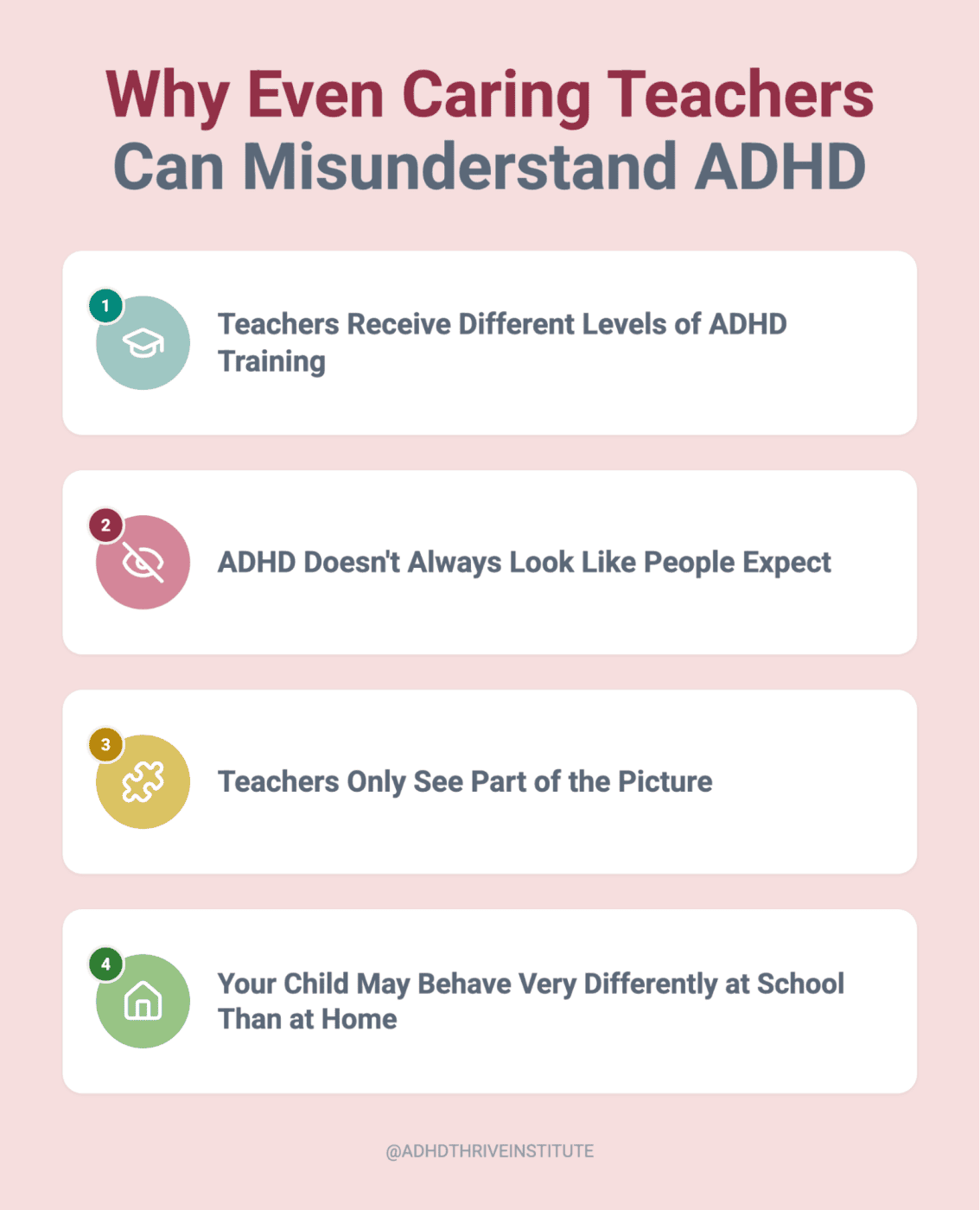
Why Even Caring Teachers Can Misunderstand ADHD
Most teachers want their students to do well. They want children to learn, feel confident, and succeed in the classroom. But even caring, experienced teachers may not fully understand how ADHD affects a child’s behavior and school performance. Here’s why…
- Teachers Receive Different Levels of ADHD Training
ADHD training can vary widely among teachers. Some receive a great deal of education about ADHD, while others receive very little. That can make it harder to recognize what ADHD looks like in real life, especially when the symptoms do not match the stereotype of a child who is constantly moving or interrupting.
- ADHD Doesn't Always Look Like People Expect
ADHD can also be easy to misread because many of its challenges are not visible. A child may look like they are not listening when they are struggling to hold instructions in working memory. They may appear careless when they lose track of materials or miss part of an assignment. They may seem unmotivated when they are having trouble starting a task, organizing their thoughts, or staying focused long enough to finish.
From the outside, those struggles can look like laziness, defiance, or a lack of effort. But ADHD is not simply a problem of knowing what to do. It affects self-regulation and executive functioning, the brain skills involved in planning, organizing, remembering, controlling impulses, managing emotions, and following through.
A child may fully understand the rule, know what is expected, and genuinely want to do well, yet still struggle to carry out that expectation consistently. That inconsistency can be especially confusing.
- Teachers Only See Part of the Picture
A teacher may see a child complete the work one day and struggle with the same task the next. They may focus well during a favorite subject but seem unable to begin a less interesting assignment. This can lead adults to think, “They can do it when they want to.”
In reality, the child’s ability to perform may change depending on interest, stress, fatigue, distractions, task difficulty, and the amount of support available at that moment.
Teachers are also managing many students at once, often with very different learning, behavioral, and emotional needs. In a busy classroom, they may only see the behavior itself, not everything happening underneath it.
- Your Child May Behave Very Differently at School Than at Home
It is also possible for a child to behave very differently at school than they do at home. Some children work incredibly hard to hold themselves together during the school day, then release their emotions once they are in a safer, more familiar environment. Others may struggle more at school because of noise, transitions, academic pressure, or social demands that are not present at home.
None of these 4 reasons mean a teacher is uncaring or unwilling to help. That’s why the goal is not to prove the teacher wrong. It is to help them understand what may be driving the behavior so everyone can work together to find support that helps your child succeed.
What Your Child's Teacher May Be Seeing
When a teacher says your child is not trying, not listening, or being disruptive, it can be hard not to feel defensive, but those comments often describe what the teacher can see, not what may be happening underneath the behavior.
Looking beyond the words can help you understand which skill your child may be struggling to use at that moment.
“He Just Needs to Try Harder.”
This is one of the most painful comments for parents to hear because many children with ADHD are already trying very hard. The problem may not be effort. It may be task initiation, or the ability to get started. Your child may know exactly what to do but still feel stuck when it is time to begin.
Working memory may also be involved. A child may hear the directions but lose track of one or more steps before finishing the task.
Sustained attention can make long or repetitive work especially difficult. Mental fatigue may also build throughout the school day, making it harder for your child to focus and follow through.
Sometimes the instructions themselves are unclear or overwhelming. A worksheet that looks simple to an adult may feel like one large, confusing task to a child with ADHD.
Instead of asking, “Why won’t they try harder?” it may be more helpful to ask, “What is making it hard for them to start or finish this task?”
“She Can Do It When She Wants To.”
Children with ADHD often perform inconsistently. They may complete an assignment quickly one day and struggle with a similar assignment the next. They may focus for a long time on a favorite activity but have trouble paying attention during a less interesting lesson.
That can make it look like they are choosing when to cooperate, but being capable of doing something is not the same as being able to access that ability reliably every time.
Performance can change based on interest, stress, fatigue, distractions, task difficulty, emotional state, and the amount of support available. A child may have the skill but struggle to use it consistently under different conditions.
A more useful question might be, “What was different on the days when this task went well?”
“He Isn’t Listening.”
A child who seems not to be listening may actually be struggling to process and remember what was said.
Working memory allows a child to hold information in mind long enough to use it. When a teacher gives several directions at once, a child with ADHD may remember the first step, the last step, or none of them.
Distractions can also pull attention away before the child has fully processed the message. Noise, movement, classmates, or even the child’s own thoughts may compete with the teacher’s voice.
Long or multi-step directions can make this even harder.
The child may not be ignoring the teacher on purpose. They may need shorter directions, one step at a time, along with a written or visual reminder.
“She Knows Better.”
Your child may know the classroom rule perfectly, but knowing a rule and using it in the moment are two different things.
ADHD can affect impulse control and emotional regulation. When a child is excited, frustrated, overwhelmed, or under pressure, they may react before they have time to stop and think.
That does not mean rules don’t matter. It means reminders and punishment alone may not solve the problem if the child is struggling with the skill needed to pause, regulate, and make a different choice.
A better question may be, “What support could help her use what she already knows when the situation becomes difficult?”
“He’s Being Disruptive on Purpose.”
Disruptive behavior can certainly affect the classroom, and teachers need to respond to it, but it’s important not to assume intent before looking at the pattern.
Ask when the behavior happens most often. Does it occur during long assignments? Noisy activities? Transitions? Unstructured time? Difficult subjects? Moments when your child feels embarrassed, confused, or overwhelmed?
Sensory demands may also play a role. Bright lights, classroom noise, crowded spaces, or constant movement can make it harder for some children to stay regulated.
The behavior may be an attempt to escape a difficult task, gain movement, get help, manage frustration, or respond to a need the child cannot explain clearly.
This does not excuse harmful or disruptive behavior. However, it helps adults choose a response that addresses the cause instead of reacting only to the behavior itself.
When parents and teachers look beneath the behavior, they are more likely to find strategies that help the child succeed instead of repeating consequences that do not solve the underlying problem.
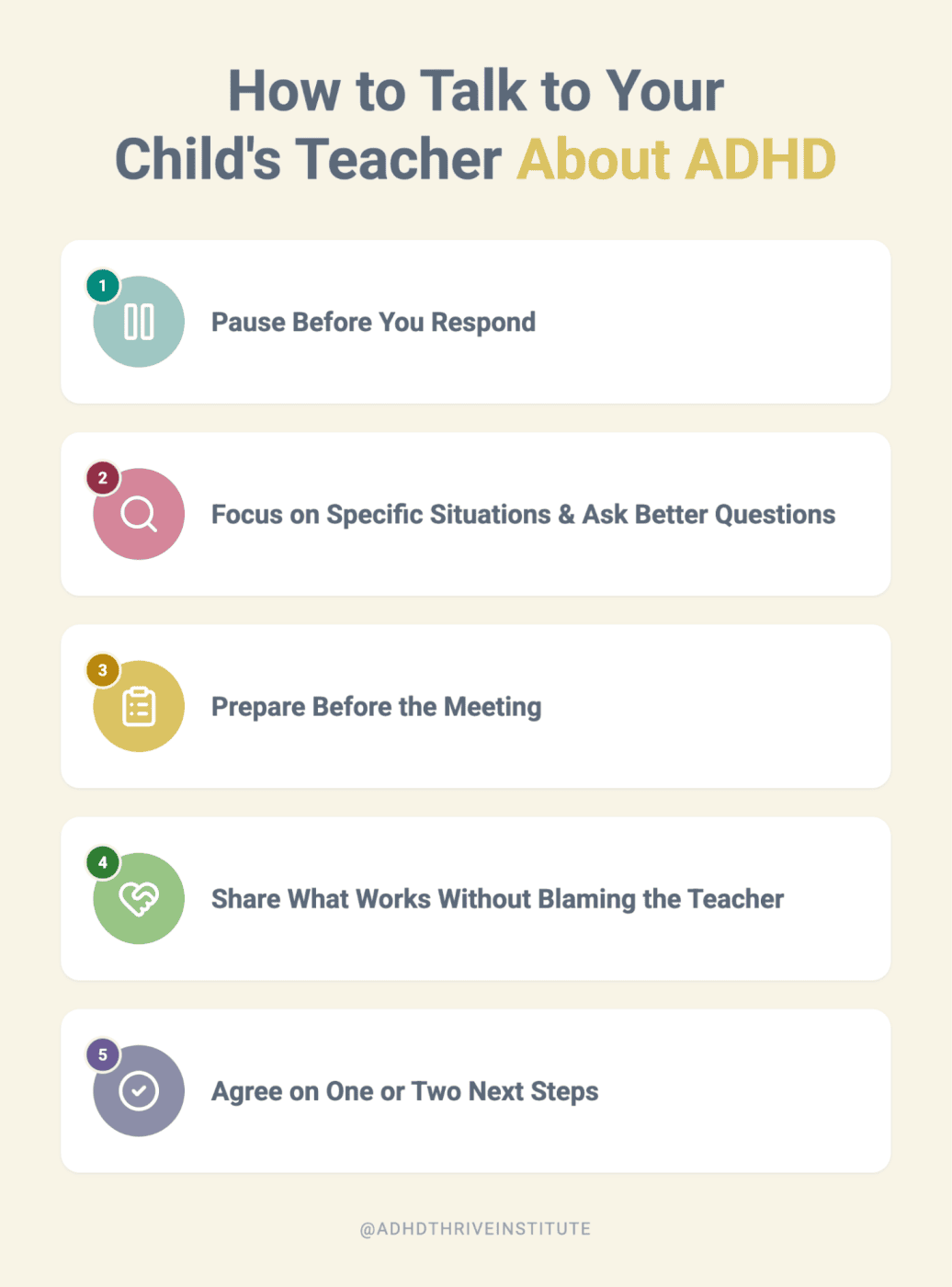
How to Talk to Your Child's Teacher About ADHD
Once you've identified that your child's teacher may be misunderstanding their ADHD, the next step is having a conversation, and how you approach that first discussion can set the tone for everything that follows. That’s why the first step is to…
- Pause Before You Respond
When you first hear a comment that feels unfair or inaccurate, it is natural to feel defensive. Give yourself time to calm down before sending an email or requesting a meeting.
The goal is not to prove who is right. It is to understand what is happening and find a way to support your child.
- Focus on Specific Situations & Ask Questions that Lead to Better Answers
One of the biggest mistakes parents and teachers can make with ADHD kids is focusing only on what a child is doing without asking why it's happening.
For example, saying, “He's always out of his seat,” describes the behavior, but it doesn't explain what's causing it.
Approach the conversation like detectives working together to solve a mystery. The more you understand the circumstances surrounding a behavior, the more likely you are to find a solution that actually helps.
Questions like these can uncover important patterns:
- When do you notice the problem most often? Is it during math, writing, independent work, or transitions between activities?
- What usually happens right before the behavior? Was your child given a multi-step direction? Asked to start an assignment? Moving from one activity to another?
- Are there certain times of day when things go better or worse? Many children have different energy levels and attention throughout the school day.
- Does the task seem too long, too unclear, or too difficult? Sometimes a child's behavior is communicating that the demands of the task exceed their current skills or capacity.
- Have you noticed anything that helps, even a little? Small successes can provide valuable clues about what supports may be effective.
- How will we know if a new strategy is working? Agreeing on what success looks like makes it easier to evaluate whether a support is actually helping.
These questions move the conversation toward problem-solving.
- Prepare Before the Meeting
Choose no more than two or three concerns to discuss, rather than trying to cover everything at once. Bring:
- Examples of patterns you have noticed
- A list of your child’s strengths and what motivates them
- Strategies that have helped before
- Relevant evaluations or accommodation documents
- A willingness to hear what the teacher is seeing
- Share What Works Without Blaming the Teacher
Explain what helps your child at home in a way that invites teamwork. For example, you could say, “We have noticed that shorter directions and a visual reminder help at home. Do you think something similar might work in the classroom?”
Additionally, don't overlook your child's strengths. It's easy for conversations about school to become focused entirely on challenges, but helping the teacher see what your child enjoys, where they excel, and what motivates them provides a more complete picture.
- Agree on One or Two Next Steps
Do not leave the meeting with a long list of vague ideas. Choose one or two practical strategies to try, decide how progress will be measured, and set a time to follow up.
Throughout the meeting, keep coming back to one simple question: “What does my child need in order to be more successful?”
A Parent Email Template for Starting the Conversation
Sometimes the hardest part is starting the conversation. A thoughtful, collaborative email can set a positive tone before frustration builds on either side.
Here's a template you can personalize:
Subject: Supporting [Child's Name] Together
Hi [Teacher's Name],
Thank you for everything you're doing to support [Child's Name] this year. I know you have many students in your classroom, and I truly appreciate the time and care you invest in helping them learn.
I'd love to better understand what you're seeing in the classroom, especially regarding [specific concern].
Would you be available for a brief conversation so we can better understand when these challenges are happening, what may be contributing to them, and what strategies we might try together? My hope is that we can work as a team to help [Child's Name] feel successful both academically and emotionally.
Thank you again for your partnership. I look forward to working together.
Sincerely,
[Your Name]
Classroom Supports That May Help
Once you and your child’s teacher understand where the challenges are happening, choose one or two supports to try. Helpful classroom strategies may include:
- Short, clear directions
- Written and verbal instructions
- Large tasks broken into smaller steps
- Visual reminders and checklists
- Planned movement breaks
- Fewer distractions
- Immediate, specific positive feedback
- Predictable routines and transitions
- Extra processing time
- Brief, discreet check-ins
- Organizational tools, such as planners or color-coded folders
These are examples, and not all-inclusive. Don’t be afraid to think outside the box. The best supports are the ones that match your child’s specific needs.
After trying a strategy, review whether it is helping your child. If it is not making a meaningful difference, adjust the plan and try something else.
What to Do if the Teacher Still Doesn’t Understand ADHD
If you have had a thoughtful conversation but your child’s ADHD is still being misunderstood, it may be time to move from informal discussions to a more structured approach.
Start by following up in writing. Send a brief email summarizing what was discussed, which strategies you agreed to try, and when you will review progress.
For example:
Thank you for meeting with me today. My understanding is that we will try [strategy] during [specific situation] for the next two weeks and then review whether it is helping [Child’s Name] with [specific challenge]. Please let me know if I missed anything.
If concerns continue, ask whether another member of the school team can join the conversation. This might include a school counselor, special education teacher, case manager, school psychologist, learning support specialist, or administrator.
Bringing in another person is not the same as going over the teacher’s head. It can add a new perspective and help the team identify supports the classroom teacher may not be able to provide alone.
If informal classroom strategies are not enough, ask the school about a formal review of your child’s needs. This may include exploring accommodations through a 504 Plan or requesting an evaluation for an Individualized Education Program, commonly called an IEP. Read this article or watch this video to learn more about IEPs and 504 plans for ADHD kids.
Keep important communication in writing, including meeting notes, agreed-upon strategies, and changes you have noticed.
Unfortunately, even when you begin calmly, school advocacy can become emotional. You may feel dismissed. The teacher may feel criticized. Meetings may start to focus more on who is right than on what your child needs.
If communication continues to break down, consider seeking guidance from a healthcare provider, therapist, school psychologist, special education professional, or educational advocate.
Outside support can help you organize your concerns, understand available options, and prepare for future meetings without turning the process into a personal battle.
Looking Beyond the Classroom
School accommodations and classroom strategies can make a meaningful difference for a child with ADHD. They can reduce unnecessary demands, improve access to learning, and give your child more opportunities to use their strengths.
But sometimes, even with good support at school, a child still seems overwhelmed. That is when it may be helpful to look beyond the classroom.
At the ADHD Thrive Institute, we take a biology-first approach. That means looking at factors that may place extra stress on the brain and body, including poor sleep, nutritional gaps, gut health concerns, inflammation, chronic stress, and nervous system dysregulation.
These factors do not cause ADHD. Addressing them is also not a replacement for appropriate classroom accommodations, professional care, or formal school support.
However, when a child’s brain and body are under additional stress, ADHD challenges may become harder to manage. Reducing that biological stress may help some children feel calmer, more regulated, and better able to handle the demands of the school day.
So, while you continue advocating for your child at school, it may also be worth asking, “Is it possible something else is going on that’s making their symptoms worse? And if so, can I do something else to support them naturally?”

You do not have to choose between school support and whole-body support. For many families, the most helpful approach includes both.
In my FREE Live ADHD Training, I explain the biological stressors that may intensify ADHD symptoms and the practical steps families can take to support a calmer, better-regulated nervous system.
Save your seat for the FREE Live ADHD Training here.
And the next time you hear, “Your child just needs to try harder,” I hope you'll remember that those words don't have to be the end of the conversation. They can be the beginning of a better one.
Frequently Asked Questions When a Teacher Doesn’t Understand ADHD
What should I do if my child’s teacher does not believe in ADHD or thinks my child’s challenges are just “behavioral” or because of a lack of discipline?
Avoid getting pulled into a debate about whether ADHD is real. Focus instead on your child’s specific challenges, how those difficulties affect learning, and what support may help. Document concerns, request a meeting, and involve a counselor, administrator, or special education professional if the conversation does not improve.
How can I explain ADHD to a teacher without sounding confrontational?
Start with specific examples rather than saying the teacher does not understand ADHD. Explain the skills your child may be struggling with, such as working memory, task initiation, or impulse control. Ask what the teacher is noticing and invite them to test one or two practical strategies with you.
What classroom accommodations help students with ADHD?
Helpful supports may include short directions, written reminders, smaller task steps, movement breaks, reduced distractions, predictable transitions, extra processing time, and organizational help. The best accommodations depend on the child’s specific needs. Each strategy should be monitored to see whether it improves access, participation, or learning.
Can a teacher refuse ADHD accommodations?
If your child has a 504 Plan or IEP, the school is responsible for implementing the agreed-upon supports. When accommodations are not being followed, document the concern and contact the case manager, 504 coordinator, or school administrator.
When should I request a 504 Plan or IEP for ADHD?
Consider requesting formal support when ADHD is significantly affecting your child’s access to learning, academic progress, behavior, organization, or participation despite informal classroom strategies. A 504 Plan provides accommodations, while an IEP may include specialized instruction. Eligibility depends on an individual evaluation and your child’s educational needs.
For further study:
Brocki KC, Randall KD, Bohlin G, Kerns KA. Working memory in school-aged children with attention-deficit/hyperactivity disorder combined type: are deficits modality specific and are they independent of impaired inhibitory control? J Clin Exp Neuropsychol. 2008 Oct;30(7):749-59. doi: 10.1080/13803390701754720. Epub 2008 Feb 4. PMID: 18608645.

Bussing R, Zima BT, Mason DM, Meyer JM, White K, Garvan CW. ADHD knowledge, perceptions, and information sources: perspectives from a community sample of adolescents and their parents. J Adolesc Health. 2012 Dec;51(6):593-600. doi: 10.1016/j.jadohealth.2012.03.004. Epub 2012 Apr 17. PMID: 23174470; PMCID: PMC3505280.

Diaba SE, Essuman YA, Singh G, Fiagbe D. Investigating primary school educators' insights into attention deficit hyperactivity disorder: A cross sectional study in the Greater Accra Region, Ghana. PLOS Ment Health. 2025 Sep 3;2(9):e0000376. doi: 10.1371/journal.pmen.0000376. PMID: 41661994; PMCID: PMC12798378.

Kasper LJ, Alderson RM, Hudec KL. Moderators of working memory deficits in children with attention-deficit/hyperactivity disorder (ADHD): a meta-analytic review. Clin Psychol Rev. 2012 Nov;32(7):605-17. doi: 10.1016/j.cpr.2012.07.001. Epub 2012 Jul 17. PMID: 22917740.

McKenna K, Wanni Arachchige Dona S, Gold L, Silk TJ, Le HND. Effectiveness and cost-effectiveness of interventions to increase knowledge and awareness of attention deficit hyperactivity disorder: a systematic review. Eur Child Adolesc Psychiatry. 2025 Jun;34(6):1769-1794. doi: 10.1007/s00787-025-02646-4. Epub 2025 Jan 26. PMID: 39864035; PMCID: PMC12198261.

Mohr-Jensen C, Steen-Jensen T, Bang-Schnack M, Thingvad H. What Do Primary and Secondary School Teachers Know About ADHD in Children? Findings From a Systematic Review and a Representative, Nationwide Sample of Danish Teachers. J Atten Disord. 2019 Feb;23(3):206-219. doi: 10.1177/1087054715599206. Epub 2015 Aug 22. PMID: 26297913.

Shaw P, Stringaris A, Nigg J, Leibenluft E. Emotion dysregulation in attention deficit hyperactivity disorder. Am J Psychiatry. 2014 Mar;171(3):276-93. doi: 10.1176/appi.ajp.2013.13070966. PMID: 24480998; PMCID: PMC4282137.

Willcutt EG, Doyle AE, Nigg JT, Faraone SV, Pennington BF. Validity of the executive function theory of attention-deficit/hyperactivity disorder: a meta-analytic review. Biol Psychiatry. 2005 Jun 1;57(11):1336-46. doi: 10.1016/j.biopsych.2005.02.006. PMID: 15950006.